Greetings!
I was all prepared today to get steep on Scottie Scheffler’s press conference from Tuesday afternoon, but Brian Rolapp delivered a banger on Wednesday that we need to immediately dive into.
Name drops today: Peter Kostis, Bob Mac, Brian Rolapp (x23)
TODAY’S SPONSOR
Today’s newsletter is sponsored by Ship Sticks.
Two things that delight me.
Brian Rolapp’s presser (which we’ll get to below).
Shipping my golf clubs with Ship Sticks.
Unless you’re flying private to your golf destinations (which, maybe you are!), Ship Sticks is a fantastic way to transport golf clubs, luggage, and travel gear ahead of your trip. Instead of lugging your way through massive airports or paying airline fees, Ship Sticks will get you from your front door to the front door of your destination without the hassle or stress you might otherwise have.
Maybe even to some of those iconic golf courses in premium U.S. cities that Rolapp so often referenced today.
Normal Sport readers can check them out right here and use the code normalsport at checkout for 20 percent off your first purchase.
OK, now onto the news.

10 Thoughts on Brian Rolapp’s press conference
As a reminder, this week’s content is partially behind the paywall (though thankfully not behind the moat). You can read it all — as well as the rest of our major championship coverage — by becoming a Normal Club member right here.
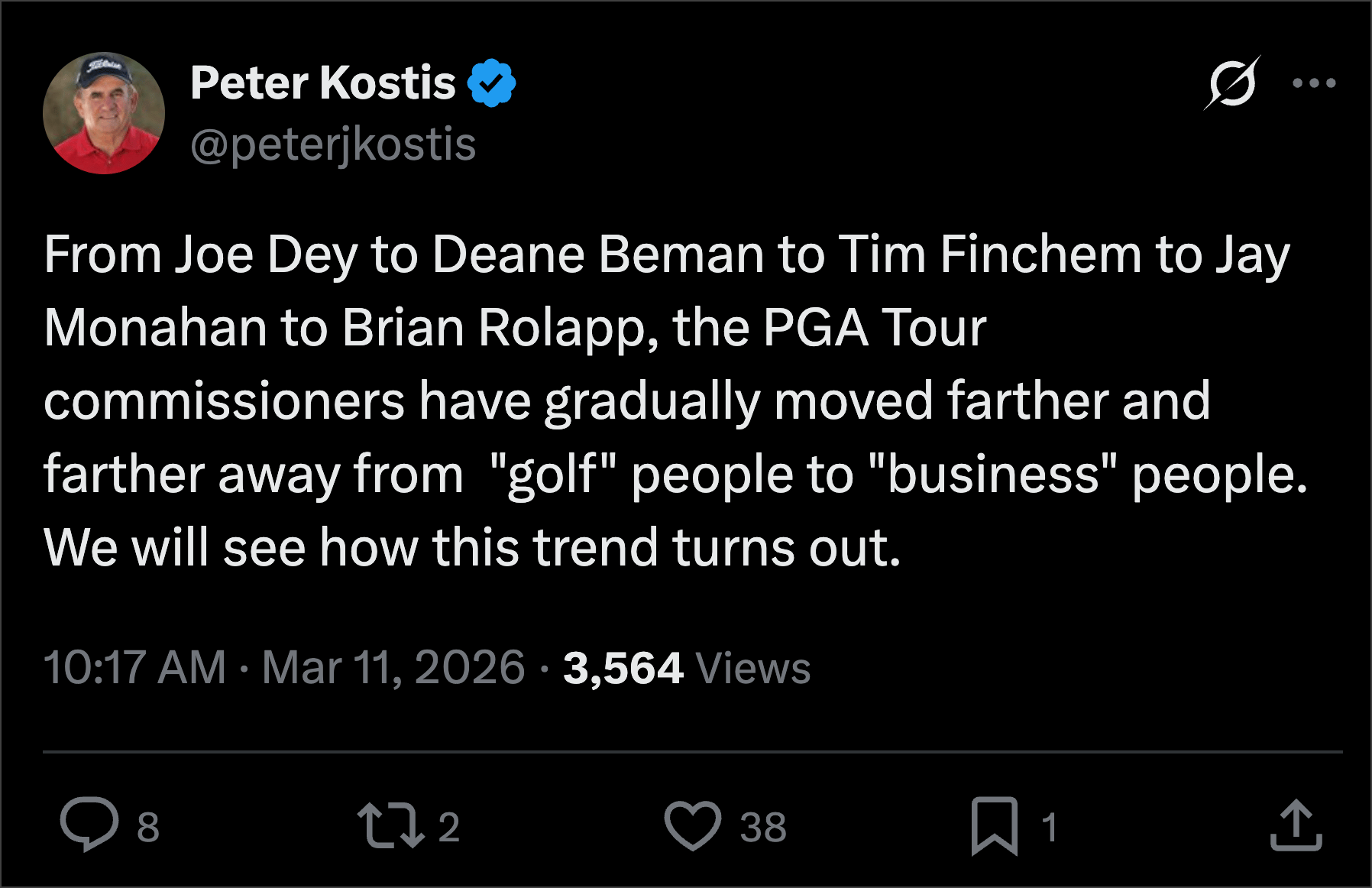
1. We’ll get to the tentpole points — which felt like they were peeled right off of a golf twitter thread! — here in a minute, but let me start with something Peter Kostis said.
Wait, Peter Kostis?!
Yes, Peter Kostis.
I understand his sentiment here, but I want to note two things. The first is that there’s a difference between being a business person who was already inside of golf (Jay) and being a business person who was not already inside of golf (Rolapp, Seth Waugh).
The latter is preferable when overhaul is needed because the latter doesn’t care about historical norms and isn’t tethered to the past the way that the former is.
The second note is related: “Golf people” often care about ridiculous things that have nothing to do with what fans want. “Golf people” often look out for their own — why do you think we play ball in hand every other week?! — and don’t say things like this.
The sports business is not that hard; just think like a fan, and nine and a half times out of ten, that's probably the right answer.
Brian Rolapp
If “golf people” were allowed to run the show — i.e. the players and their cohorts — I’m not sure any of us would like the results very much (and we may end up with 800cc driver heads). That’s the benefit of someone from way outside the golf ecosystem coming in to right the ship.
2. When he was talking, it did feel a bit like Rolapp had just gone back and listened to all the (many) podcasts, newsletters, tweets and various other communications about the Tour’s issues that those of us who participate in golf twitter have produced. Then he just … picked off the best and most reasonable parts. And now he’s going to implement them? All of this feels a bit too good to be true, which means it probably is and this tweet from Gabby was a good reminder of that.
3. I think my favorite quote from Rolapp was his opener.
It was a throwaway but I also think it said a lot.
We take a lot of pride in the Players. And with all the major talk, some may say even too much pride.
Brian Rolapp
It was self-deprecating without being self-defeating. It was amusing without being silly. It was being in on the joke without being the butt of it. It was someone reading the room and the situation with a ton of self-awareness.
And it launched 50 minutes of handling every single question with expertise, thoughtfulness and more transparency than anyone thought he would. A masterclass.
And the thing that struck me most when he got done was how … easy it seemed for him. The camera lingered as he walked off the stage, and he looked just as fresh as when he started. Like he could have done it all over again.
When Jay did these pressers, he always looked like he needed a week-long vacation after they were over. Rolapp just seems built for this spot more than Jay ever did, which is what should be expected from a world class CEO.
When he talks about collaborating with ANGC, the USGA and other golf organizations — like he did on Wednesday — it’s actually believable that he could hold court in those rooms. This is a good thing for an organization that has seemingly taken a back seat for a very long time.
4. Now let’s just go through each of the six themes he mentioned, one by one. The first is a late January-early September schedule that includes …
• 21 to 26 elevated tournaments.
• This includes Players, majors and team events so 15-20 PGA Tour owns.
• A second track of PGA Tour events that will “ladder up” to the elevated ones.
Yes.
Even hell yes.
I wrote last Friday that I’d love to see a 21-tournament schedule and laid out here what tournaments I would like that to include.
It’s a lot of golf in basically seven months, and there was a really good discussion on Golf Channel after Rolapp’s presser about how difficult it is going to be to get independent contractors on board with playing that many mandatory events.
I think that’s correct. I think three reasonable solutions for this are as follows.
1. Make it extremely difficult to get into the following year’s Tier 1 events.
2. (Related) Allow one free skip and then start heavily penalizing with negative points.
3. Make some of your co-sanctioned stuff count for Euro Tour membership.
If Rory and Tommy need four events to fulfill their European Tour membership, co-sanction two or three events like the Scottish and Irish and let those count going both ways. I don’t know if everyone is on board with that, but I think it solves 98 percent of your issues.
Let’s look at Scottie as a superduperstar problem. Will he play that much? I mean … he played 22 events, including the Ryder Cup in 2025. If you limit his choices by creating a 21- or 22-event schedule … I mean, what is he going to do? Not play them?
The Euro guys — especially Rory — are a bigger problem. Rory played 23 events last year, including the Ryder Cup, but six of those were Euro Tour. So only 17 PGA Tour/Players/majors. That’s a tougher ask, but also if he misses one or two a year, that’s OK. He’s a very unique case that isn’t going to come around very often, and you’re building for 20 years from now — not 20 weeks from now — anyway.
5. Bigger fields, more cuts.
A key consideration has been establishing more consistent fields to the PGA Tour. This means moving away from small fields and no-cut events. Our best events will have larger fields. Ideally, we are targeting something closer to 120-player fields with a cut.
Brian Rolapp
Yes, no notes.
When asked about sponsor exemptions, Rolapp said this.
I think, you know, as far as sponsors, it is my opinion we need a better competitive model because we should be delivering fields to the sponsors. We shouldn't make them work hard to put together a field. We're delivering them something, and they're supporting that. I think we need to be better partners in that.
Brian Rolapp
I agree with this, but I also understand the desire from AT&T is that when they throw $30 million at a tournament, they absolutely want their biggest partner — Jordan Spieth — to be there. To which I would say, Sorry, that’s not how this is going to work anymore.
You may lose a little money in the short term, but — and Ryan Lavner made this point on Live From — if Spieth can’t be one of the 120 best guys then you are doing a disservice to the future of your business to continue holding on to something that isn’t working.
I … might also be talking to myself about Spieth right now.
6. Here’s the third pillar.
Number three, we want to open big with a marquee event at an iconic venue in the west, among other things, allowing us to finish on network television in primetime on the west coast.
Brian Rolapp
I prefer Australia —> Hawaii —> Phoenix, but again agree with this.
7. On big markets.
Number four, we are also looking closely at where we play. Today the PGA Tour competes in only four of the top 10 largest U.S. media markets. That is an opportunity. We are evaluating markets like New York, Chicago, Philadelphia, San Francisco, Washington DC, Boston, and many others, places where there is a strong fan demand for our sport, and a chance to reach new fans.
Brian Rolapp
I am only in favor of this if it means getting great golf courses in those areas. If the biggest revenue driver for the PGA Tour is a new media rights deal — and it is! — then I’m not as concerned about where the tournaments are as I am about whether they’re at amazing golf courses in places where a lot of people show up. Prioritize those two things over big markets.
I thought Rolapp’s reaction to courses was fascinating.
I think the course is vital. I think in a perfect world, you would have a big market and an iconic course. But we don't live in a perfect world. We live in the real world. The intersection of those two things are often very rare. So you try to do the best you can.
But I think if we can't marry those two consistently or all the time, we do want to make sure the courses we play are meaningful, are set up meaningfully, are challenging, and are championship courses. That's how we look at it. What we have this weekend is a standard. That is the standard we're chasing. If in a perfect world we could create every event to feel that way, that would be really good day.
Brian Rolapp
What he means by “this weekend” is the Players Championship. And I agree with him. If you could have 16 Players Championships, five majors and the Presidents Cup or Ryder Cup every year …. I mean … whew buddy. I guess this is just what the NFL has every year, but I would weep with joy over that slate.
8. On the R-word, relegation.
… We are evaluating the role of promotion and relegation between these two tracks within our competitive model, an added element that we would bring to life in the second track of events I described earlier. What we envision is a merit-based system that leans into what makes professional golf so compelling, players earning their way to the top, with every event having greater meaning.
You see this work powerfully elsewhere, including in English football, where clubs move between the premier and the championship based on their performance.
Brian Rolapp
Yes, but make it firm. No career money exemptions. Make it difficult to get into the 16 but easy to understand how it’s done. Rolapp did note that relegation is hopefully a rising tide that lifts both Tier 1 and Tier 2 events, which … maybe.
But importantly, having both tiers keeps good storylines intact for Tier 2 events and keeps the inventory provided to broadcasters the same (or even increases it!).
9. And finally …
We have heard from our fans and our partners, they want more drama. We are considering the potential integration of match play, either at the Tour Championship or across the postseason as a whole, bringing win-or-go-home moments to the conclusion of our season.
Brian Rolapp
Yes, but the key here is that it needs to be the final 16 players in the regular season standings (just get rid of the other two playoff events). Any match play before final 16 will lead to pretty uninteresting matchups. But as a finale (perhaps at Pebble?!), it could rule.
Here are your matchups if you took the final 16 at the end of the regular season last year.
1. Scottie vs. 16. Cam Young
8. Spaun vs. 9. Tommy
4. Henley vs. 13. Conners
5. JT vs. 12. Novak
3. Sepp vs. 14. Ludvig
6. Griffin vs. 11. Mav
2. Rory vs. 15. Bob Mac
7. English vs. 10. Keegan
Bob Mac is the most 15 seed that’s ever existed in golf, but how good are those?! The problem with WGC match play is that stars were eliminated too early, but this model is using the regular season to eliminate the non stars before you get to the finale.
And your quarterfinal matchups probably would have been something like …
Scottie-Tommy
JT-Conners
Ludvig-Griffin
Rory-Keegan
There is very little chance that the players — who still have majority voting on the board and thus still have the power (in theory) — vote in favor of all of this. However, Todd Lewis did point out on Golf Channel that Rolapp scored an easy early win by signaling that he wants to move fields back to 120 players.
Even if they got 80 percent of the way there with these changes, it would be considered a complete overhaul for the Tour and one I would be absolutely fired up to see.
10. A quick aside on Tiger: It’s amusing to me that he’s helping sort out a mess that he inadvertently helped create. My broad strokes theory is that the Tour leaned so hard on him over the years that it didn’t see innovation as necessary. It became complacent because it could afford to because Tiger brought in SO much money. And here we are.
Anyway, I’m also excited about the golf this week, and I’m picking ….
A member of the Euro Ryder Cup team.
Who has absolutely crushed at Augusta recently.
Has an amazing TPC Sawgrass record.
And the dreamiest swing imaginable.
Rory?
No.
Thank you for reading our handcrafted, algorithm-free newsletter. Don’t forget to check out our Rory/Masters book, and thank you as always for reading.
We appreciate your support of our business.


.svg)