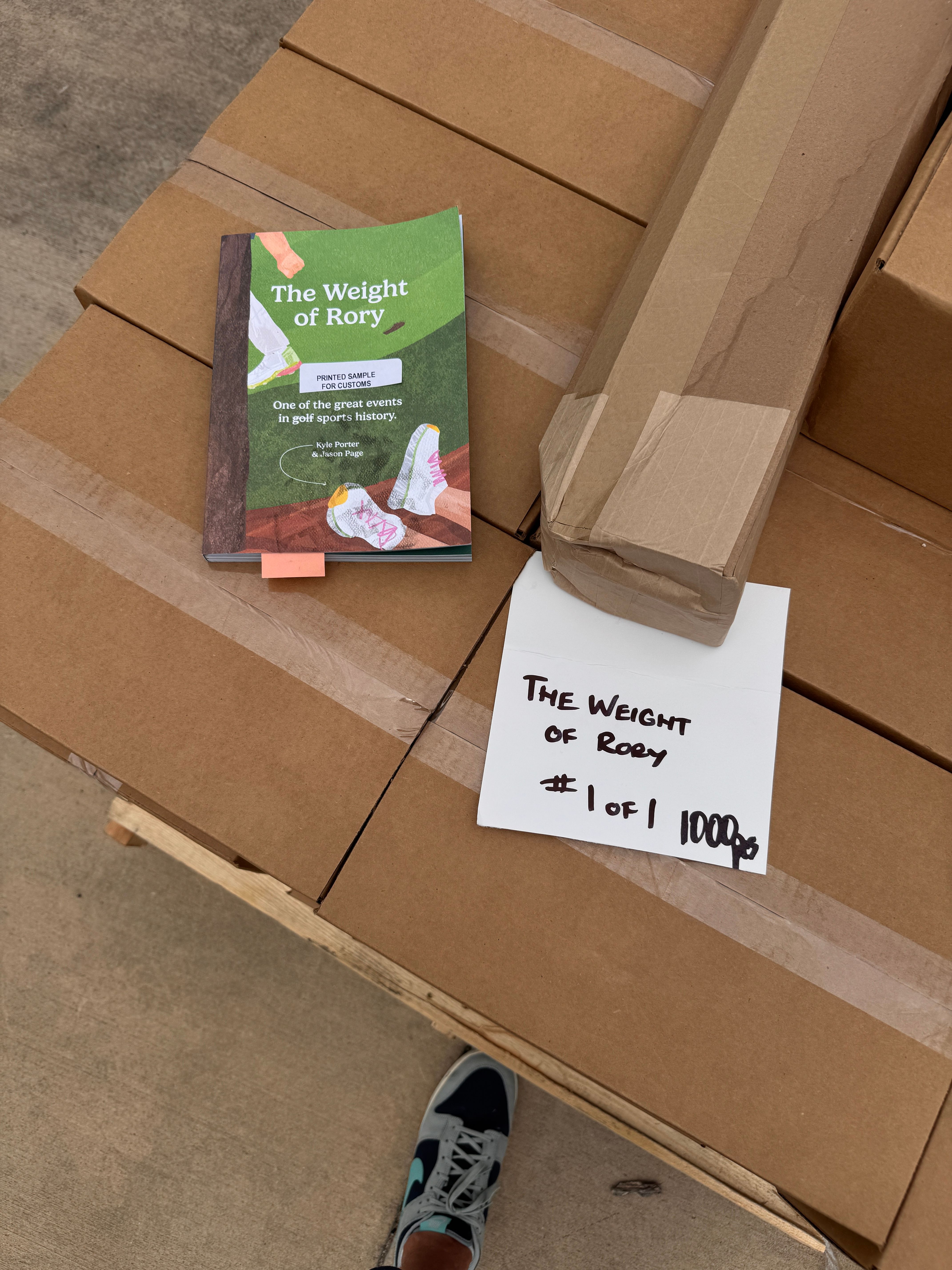
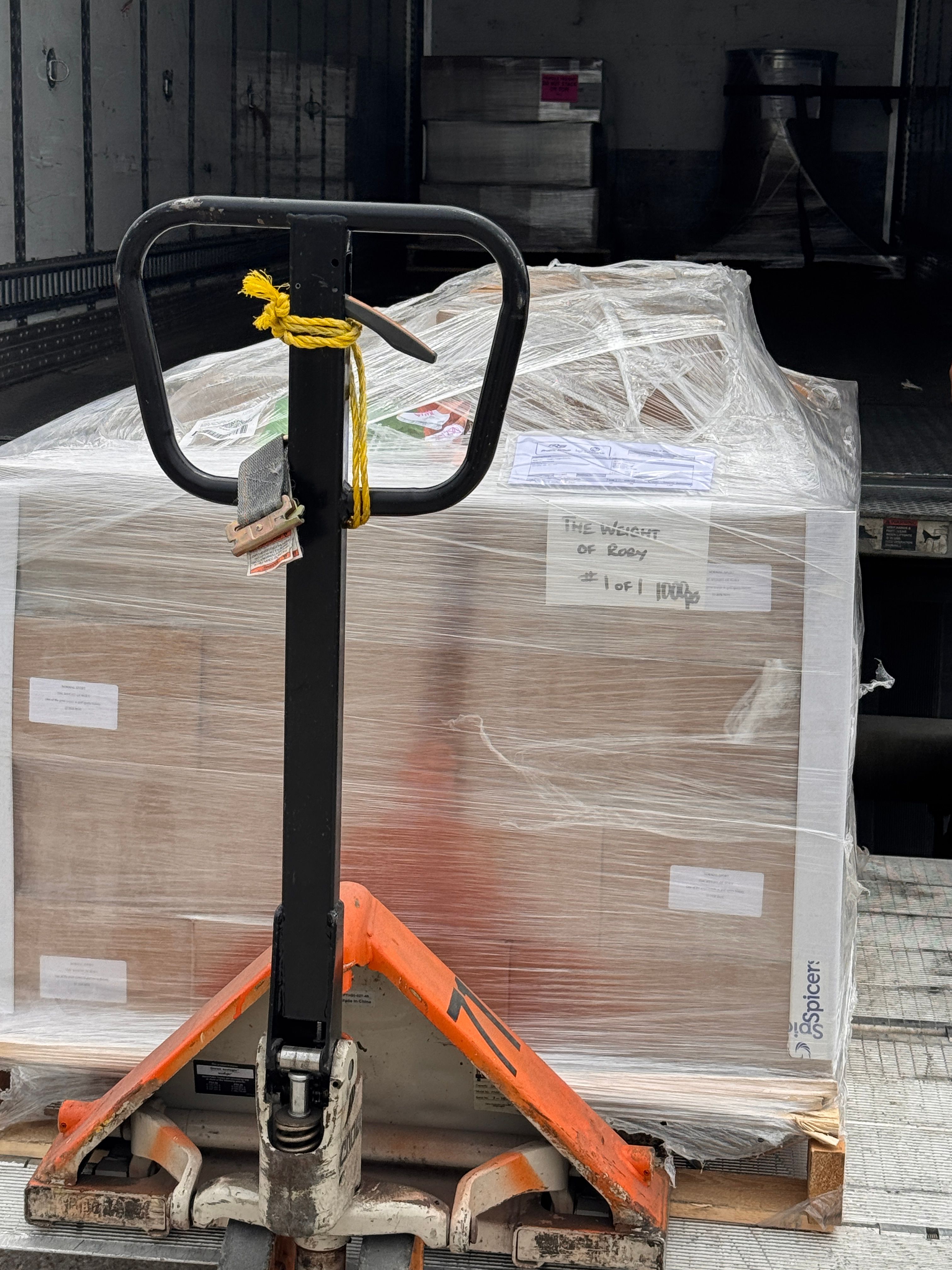
Our book is here. I’ll be opening the boxes later tonight and toasting a celebration signing and sending all evening, but here are some photos from the delivery this afternoon.
It feels both thrilling and relieving to be holding a physical artifact that we put together for all of you. If you haven’t purchased one yet, the pre-order stamp has been erased, and you can simply buy right here.
Shout out, as always, to Greig Anderson whose design makes the book sing and to Prolific Group for their flexibility and shepherding to get this project completed.
This is a longer post for a different time, but the publishing industry is outrageously opaque — which is part of the reason I’m so adamant about owning and publishing myself — so to have a designer and a printer that make the process a joy is more of a relief than it seems like it probably should be. I’m grateful for it.
Name drops today: Dublin (not that one), Aramco (kinda not that one), Virginia (not that one) and ball speed (but not that one).
TODAY’S SPONSOR
This newsletter is brought to you by Charlie Golf Co, who we are proud to partner with throughout 2026. We like to say we partner with companies whose products we enjoy and have stories that we love. Charlie Golf Co. is certainly among those.
Even better that their story is, uh, very normal sport.
Charlie Golf Co. started with toddler golf bags priced at $88, which was arguably the best deal in all of golf equipment given the quality of their work (they have since raised the price to an outrageous* $98!).
*kidding
Charlie Golf Co. founder, Tyler Johnson, tells the story of how his grandfather’s race car number (88) inspired the pricing. Again, normal sport.
My dad became the superintendent at the small town golf course I grew up playing. Population: 2,500. He took the roof panel off an old race car and put it on our driving range. It had a big number 88 on it.
He walked 88 paces and propped it up as a target.
When I was young, I spent so much time trying to hit that 88-yard target. There was nothing better than hearing that sound of the ball bounce off of it.
To this day, I get excited when my rangefinder says 88 yards.
When we were deciding on a price for our toddler bags, $88 made so much sense.
I can connect with it. It might not be smart business wise. People tell me I’m not charging enough. That might be true. But I am also tired of the outrageously priced golf equipment I see in the adult golf space.
There is a bigger purpose to this little business.
We want families to enjoy time on the course together. This bag might be the kids’ first introduction into the game.
I want it to be affordable for all families.
Tyler Johnson
Amazing.
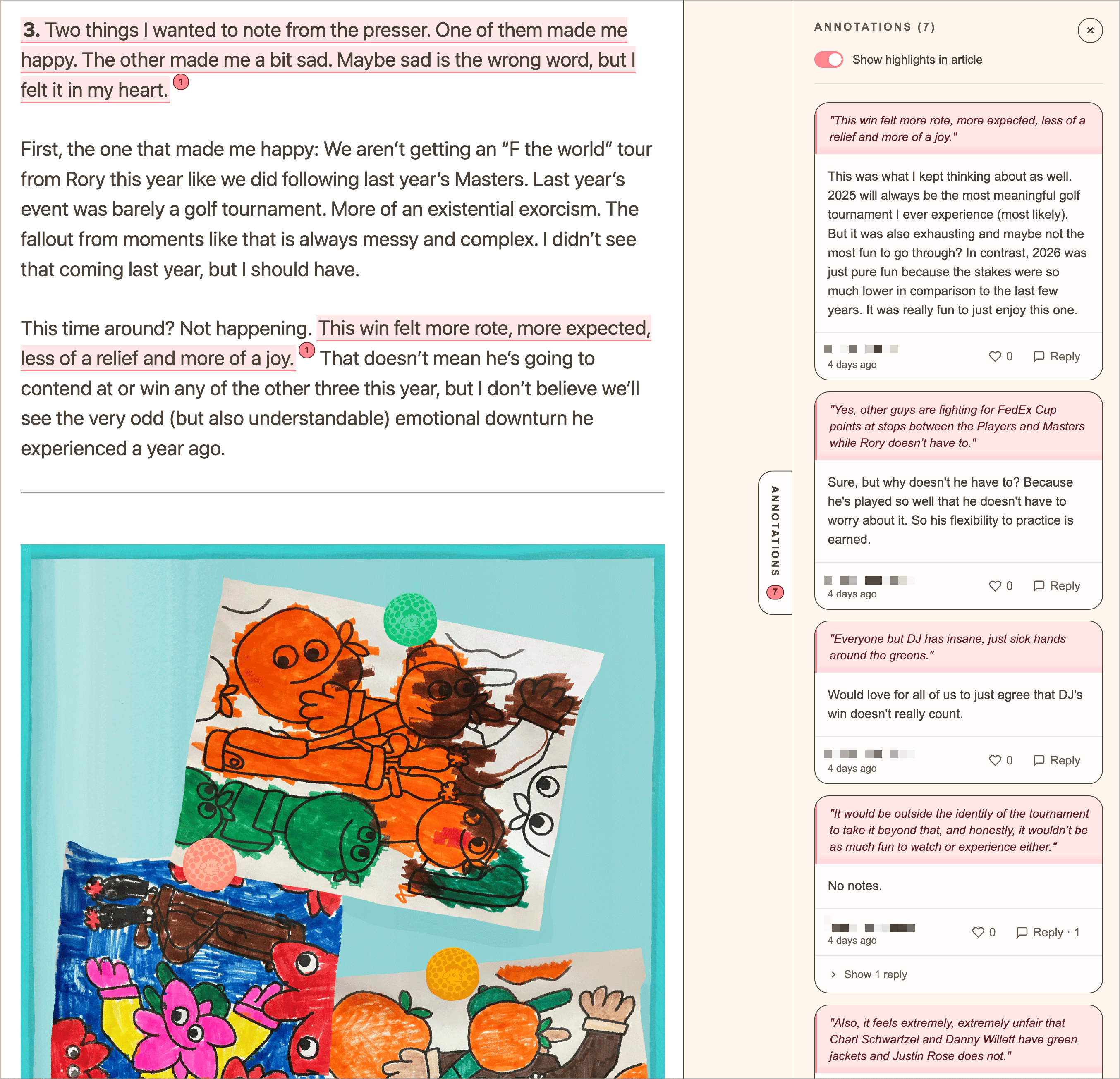
And today Jason illustrated this story and what we think Tyler's son Charlie's school locker might look like.
You can check out everything Tyler and Charlie Golf Co. are doing at the link below. I can pretty confidently promise you there aren’t any better golf businesses whose pricing structures were inspired by family race car enthusiasts.
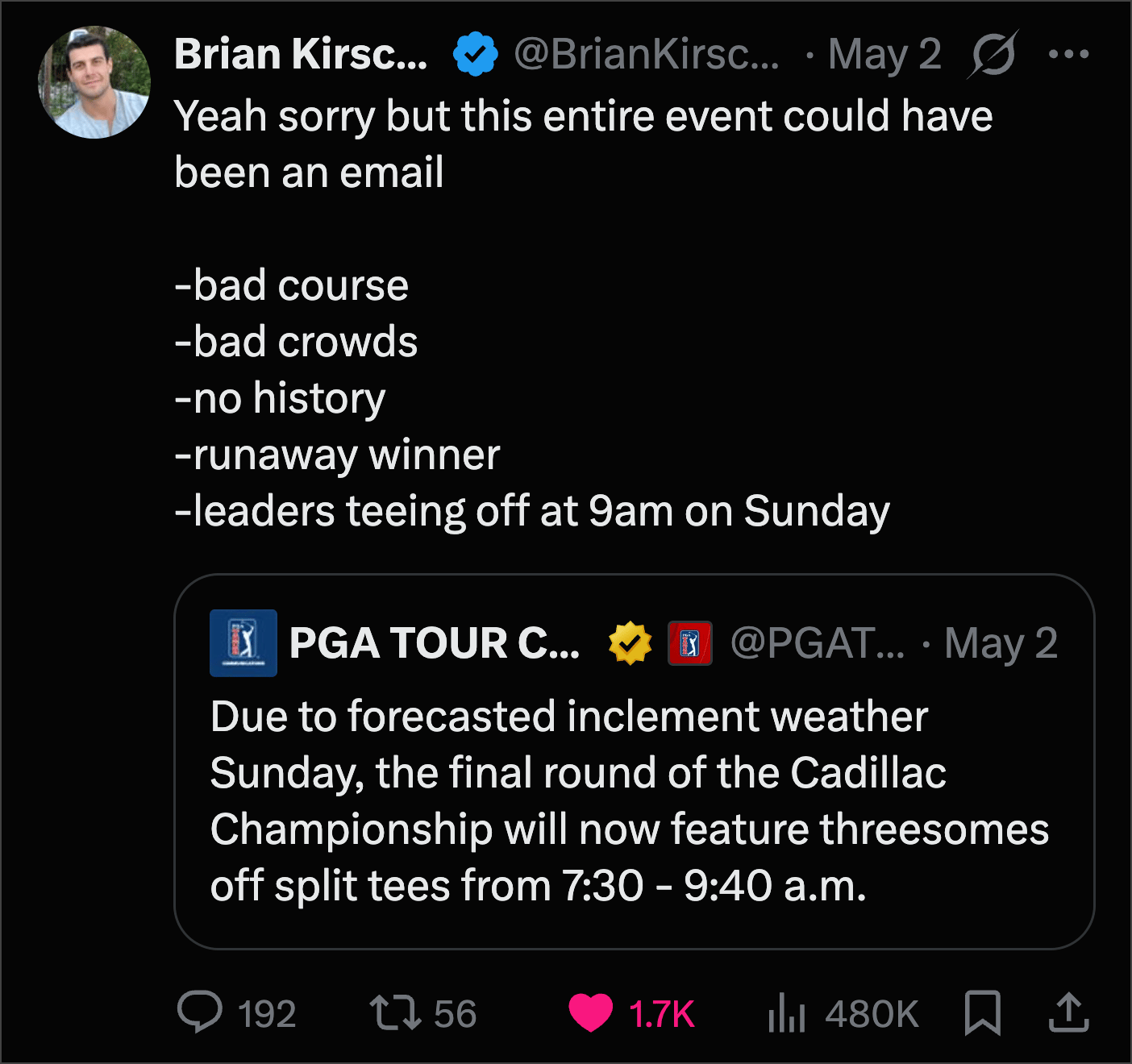
I found myself disinterested with and ambivalent toward the Doral event all weekend. Did I give it a fair run? Probably not. I was caught up doing youth baseball and a number of other things, but every time I tuned in, the broadcast was rife with all the energy of a U.S. Open local qualifier (and almost that many people).
I’m just not sure that Trump’s venue in Miami on F1 weekend (or, honestly, any weekend) is it. In fact, I’m pretty sure it isn’t.
There have been a lot of arguments in favor of the Tour moving toward bigger markets (New York, Boston etc.). I don’t necessarily disagree with this idea in principle.
However, when I think of the best tournaments in terms of atmosphere and crowd participation, I think of places like Cromwell, Connecticut, Jacksonville, Florida and Dublin, Ohio.
In-person atmospheres affect the television product in any sport, and the television product in golf is — by a wide margin — the more important revenue stream for the PGA Tour.
When the in-person atmosphere looks like this on a Saturday afternoon at one of the (alleged) best events of the year, it creates a television product that is not going to benefit the Tour in the long term.
So I don’t know what the Tour should do here, but I do know that this was not a super successful return to Doral. Add it to the pile of things Rolapp needs to figure out and navigate as the Tour tries to determine what the best path forward actually is.
Stat of the Week
Nelly won again on Sunday, which means she has the following in 2026.
3rd place finishes or worse: 0 2nd place finishes: 3 1st place finishes: 3
This is insane. She has lost to two humans in three tournaments.
Mayakoba: 0 Chevron: 0 Aramco: 1 (Coughlin) Ford Championship: 1 (Joo Kim) Fortinet: 1 (Joo Kim) Tournament of Champions: 0
Scottie Scheffler stuff. Better than Scottie Scheffler stuff. And while Nelly winning Mayakoba doesn’t move the needle for me in terms of changing what I think about her, it does reinforce what I wrote on Friday about how she has a real chance to become the best modern American women’s golfer of the last 50 years.
How is This App Free?
Some absolute bangers over the last week from the usual suspects.
Let’s jump into them.
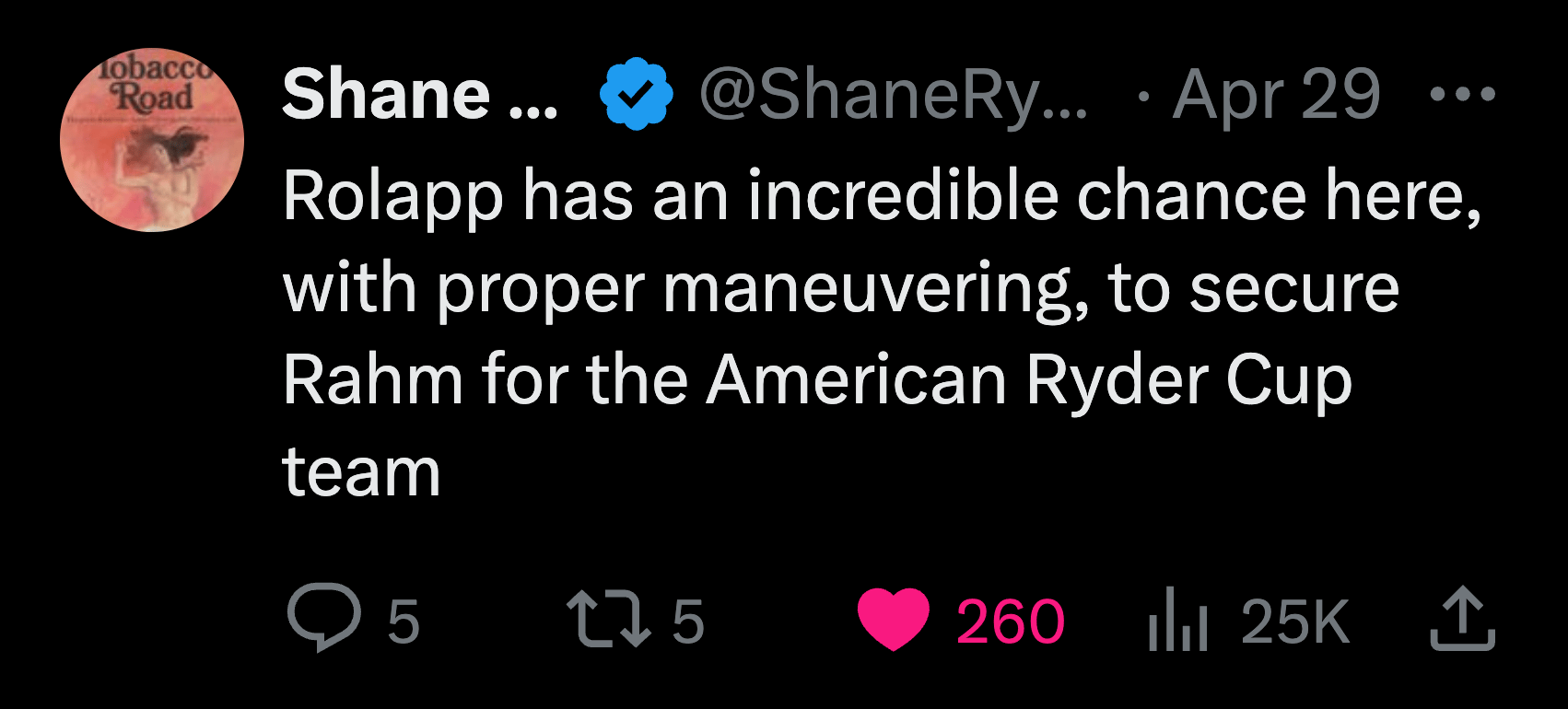
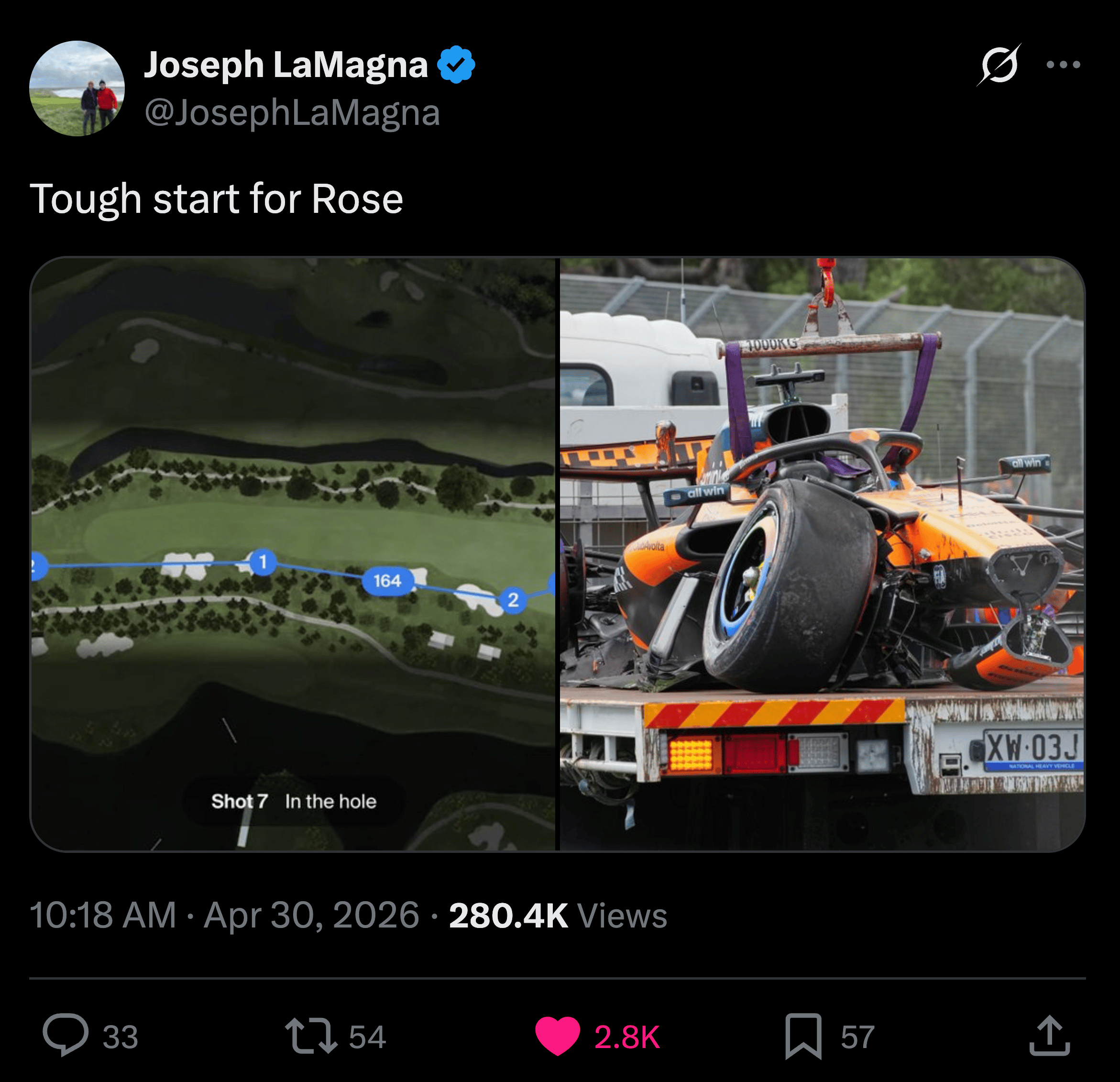
I haven’t checked the comments, but I would imagine a number of Euros are taking this way (WAY) too seriously.
Perfection.
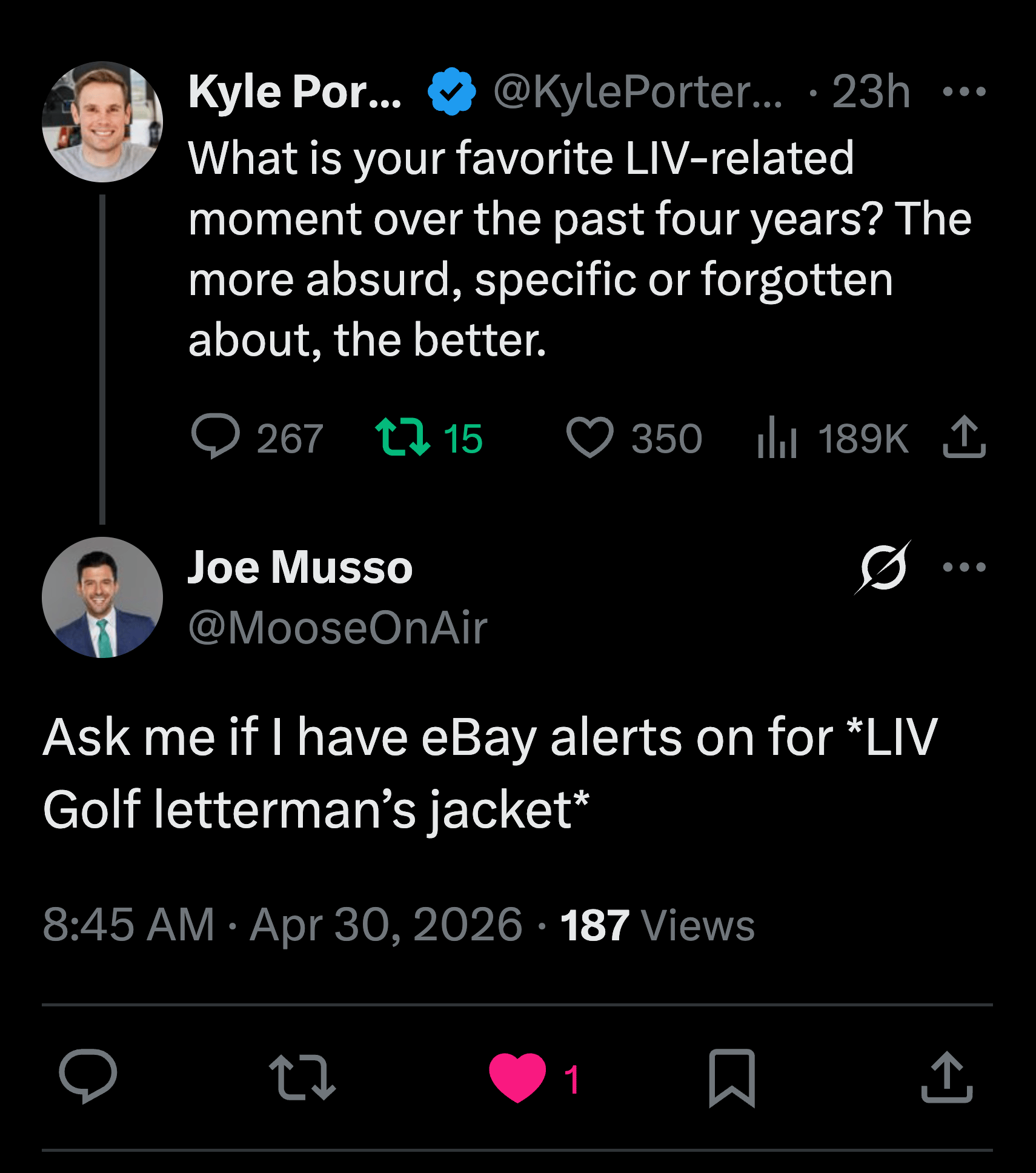
Imagining someone setting up these alerts got me pretty good.
Again, no notes.
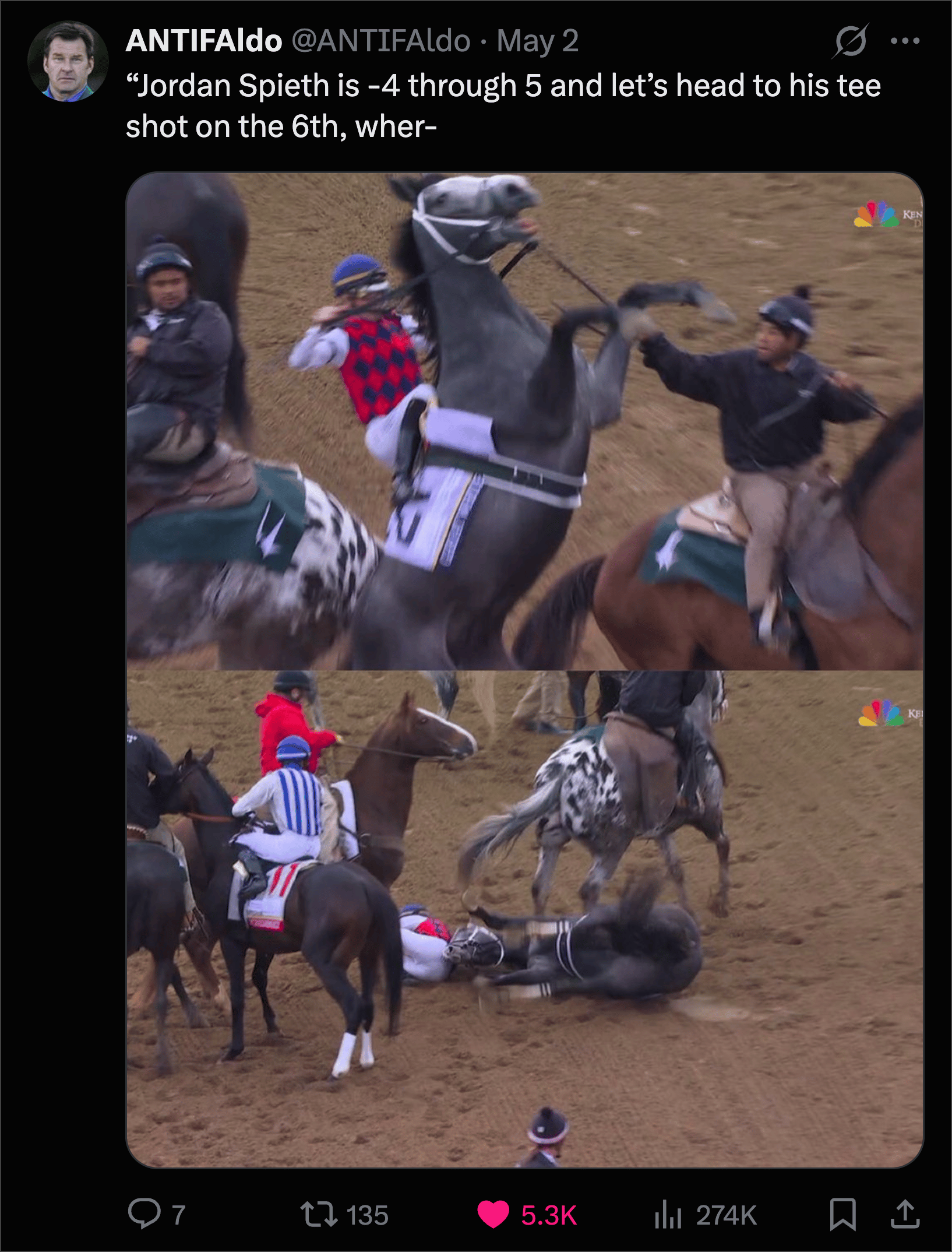
Corrupt Golf Media
• This Jeff Passan article on how 100 is the new 95 in MLB is terrific. I — like many — am obsessed with speed. Ball speed, pitch speed, whatever you want to put in front of me. And as someone who grew up in the baseball world, the number of guys who throw 95+ now is astonishing.
If you touched 95 when I was playing, you were a king. Now? You’re just the next guy. Definitely some golf parallels in there.
• KVV said this thread deserves a Pulitzer. He was joking. But maybe it does. It’s a bit of a tongue-in-cheek look at the insanity of our daily digital lives (see note at bottom of newsletter for more of my thoughts on digital vs. physical world).
• I was staggered by this podcast by my guy, Charlie Warzel, on how the clips are the content now. It is fascinating. I don’t know what in the world to do with it, but my mind was spinning by the end.
• This from Gabby on the future of LIV is must read stuff. Some very intense statements about the future of LIV, including, for example …
“I think it’s going to be very hard to raise anywhere close to the amount of money that they’ve been burning. Even if they cut it in half, it’s still going to be incredibly difficult,” the investment banking executive says.
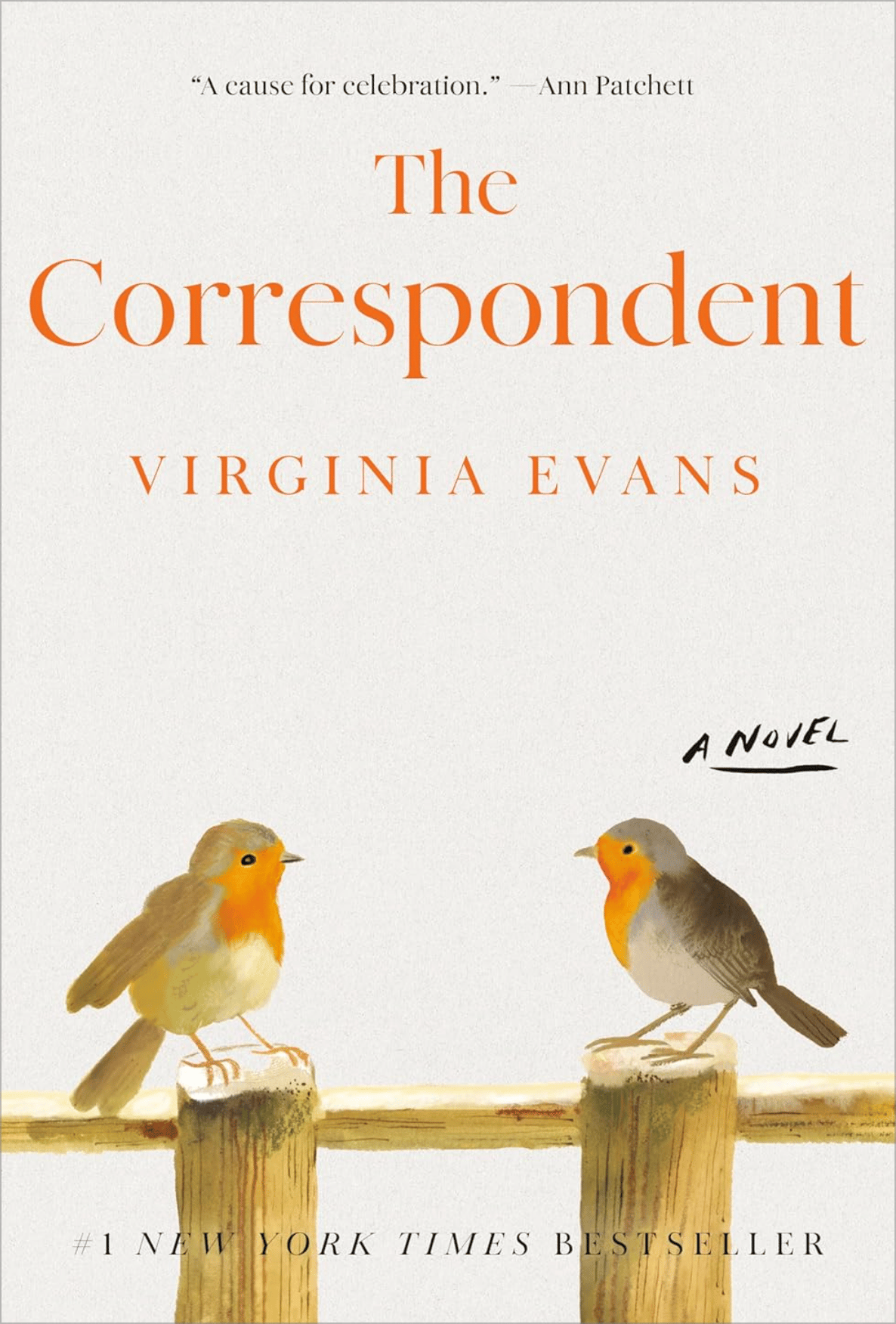
• I read The Correspondent over the weekend after my friend, Garrett, sent it to me. And I have to say I think it’s the best book I’ve read in the last several years.
New Feature
If you are a Normal Club member, we are introducing annotations on our site today.
I got tired of folks not being able to comment on my newsletters — repeatedly hearing your own voice gets rather old! — so Normal Club member, David M., built this little annotations tool for all members to use.
To be clear, non-members can see the annotations, but they cannot write their own. Also, you have to be logged in to write. You can do so on this very newsletter right here.
Rap Genius — of all places — was my inspiration (normal sport).
I always thought it was so cool that people could annotate lyrics of songs based on how those lyrics spoke to them. Claude — and having very smart members — made getting this done much easier for me than it would have been 10 or 20 years ago.
So if you’re a member, I would encourage you to go use it on our website. We are planning on taking the best annotations at the end of the year and including them as footnotes in a “best of” book of that year’s newsletters so that you all feel some increase in ownership in what we’re building here.
Ryder Cupdate
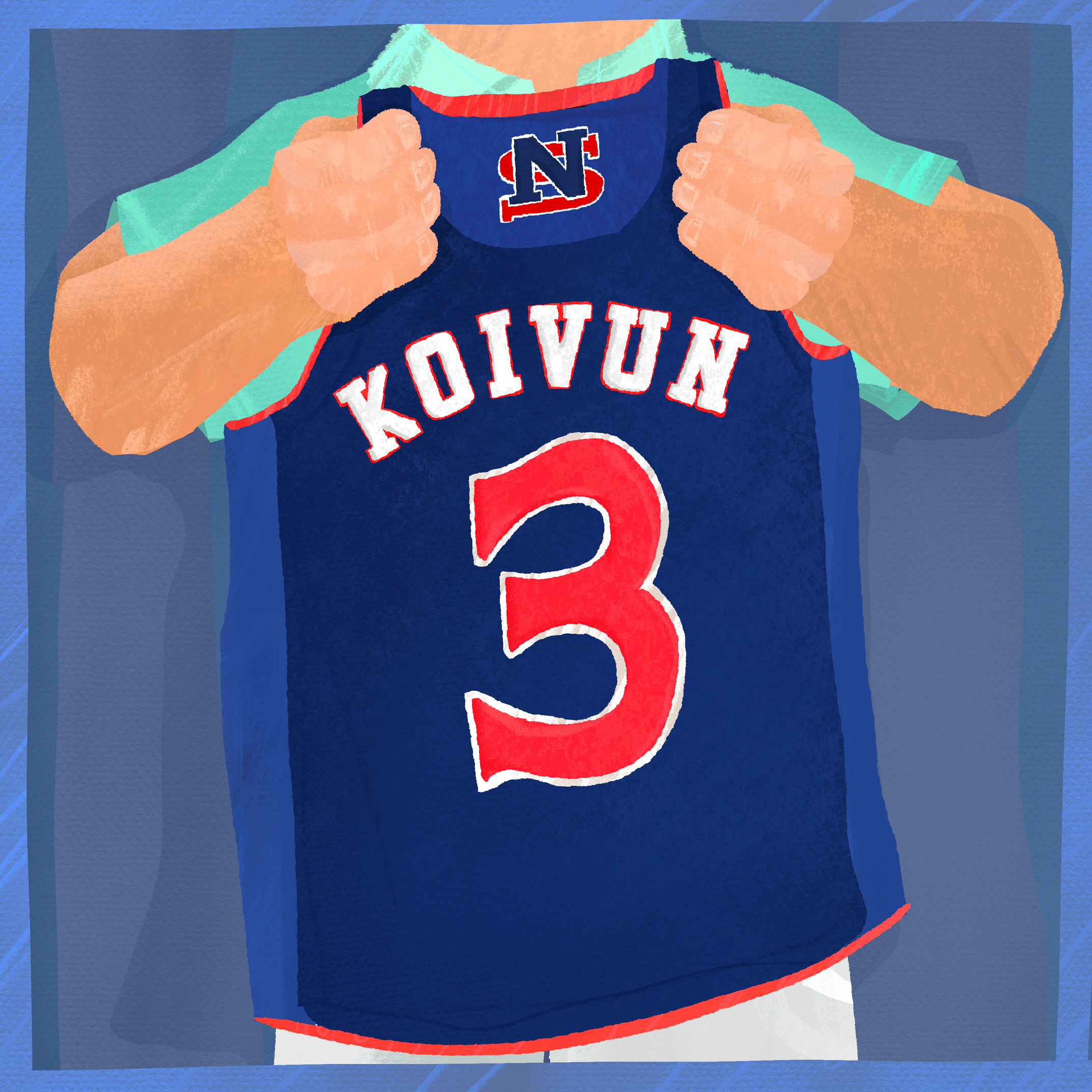
I think Jackson Koivun is going to be on the 2027 U.S. Ryder Cup team.
This sounds insane for someone who was playing in something called the Mason Rudolph Championship a few weeks ago, but that’s how good he is and how confident I am that he’s going to remain that good for a long time.
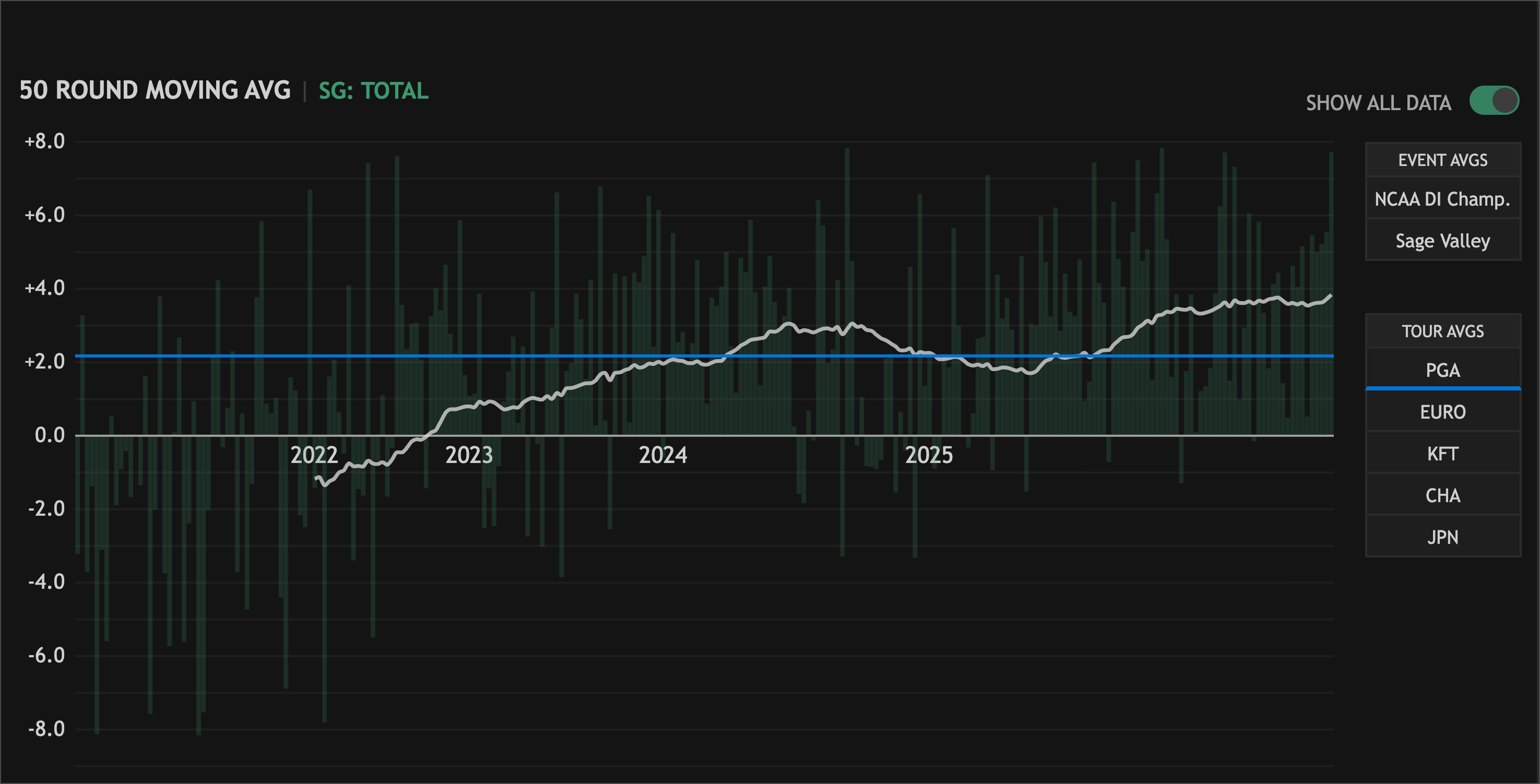
The numbers are staggering.
His current rolling normalized SG number is approaching 4.0, which is 4.0 strokes better than the average D1 player per round and 2.0 better than the average PGA Tour pro.
This is equivalent to Ludvig, Matt Fitzpatrick and Xander Schauffele’s current numbers.
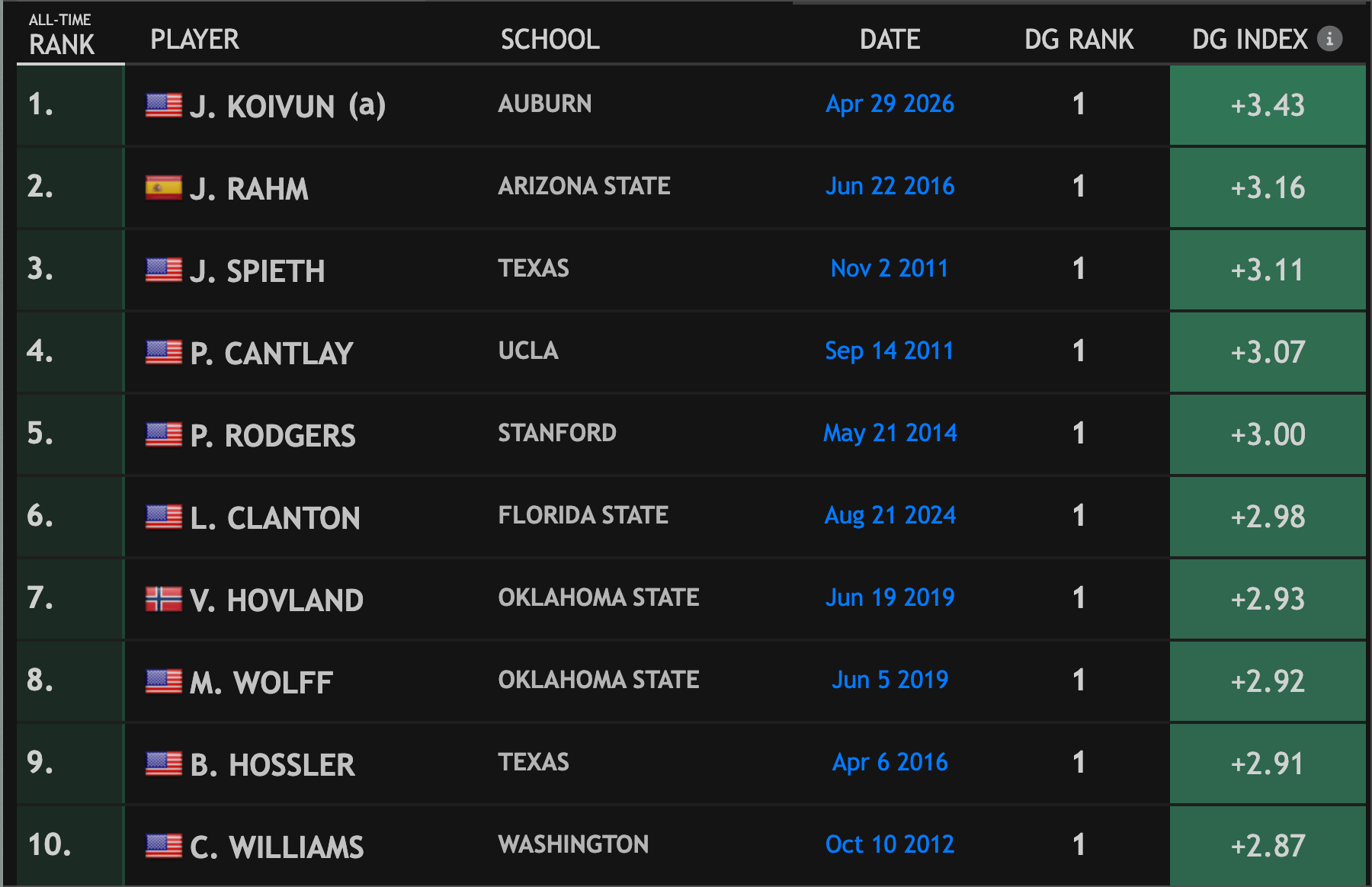
Additionally, he’s the best amateur Data Golf has measured in the last 15 years. Better than Rahm. Better than Spieth. Better than both Patricks, all the O-State boys and anyone in recent college golf.
At his best, Koivun has been a full shot per round better than the best amateur stretches from Nick Dunlap, Bryson and Michael Thorbjornsen.
Of the other nine best amateurs of the last 15 years, four have been Ryder Cuppers, and two — Spieth and Hovland — made the first team they were eligible for as a pro (Rahm turned pro three months before Hazeltine).
Of course Koivun’s pro success is far more dependent on his mental makeup than the numbers. I noted this in the video above, but one college coach who went against Koivun over the last several years told me he’s the most competitive player he’s seen since Tiger Woods. Obviously not on Tiger’s physical level, but this coach said he’ll be a top 20 player in the world one year into his PGA Tour career.
If that’s the case then he will almost certainly tee it up for Jim Furyk’s squad at Adare Manor in just 16 months from right now.
Question of the Week
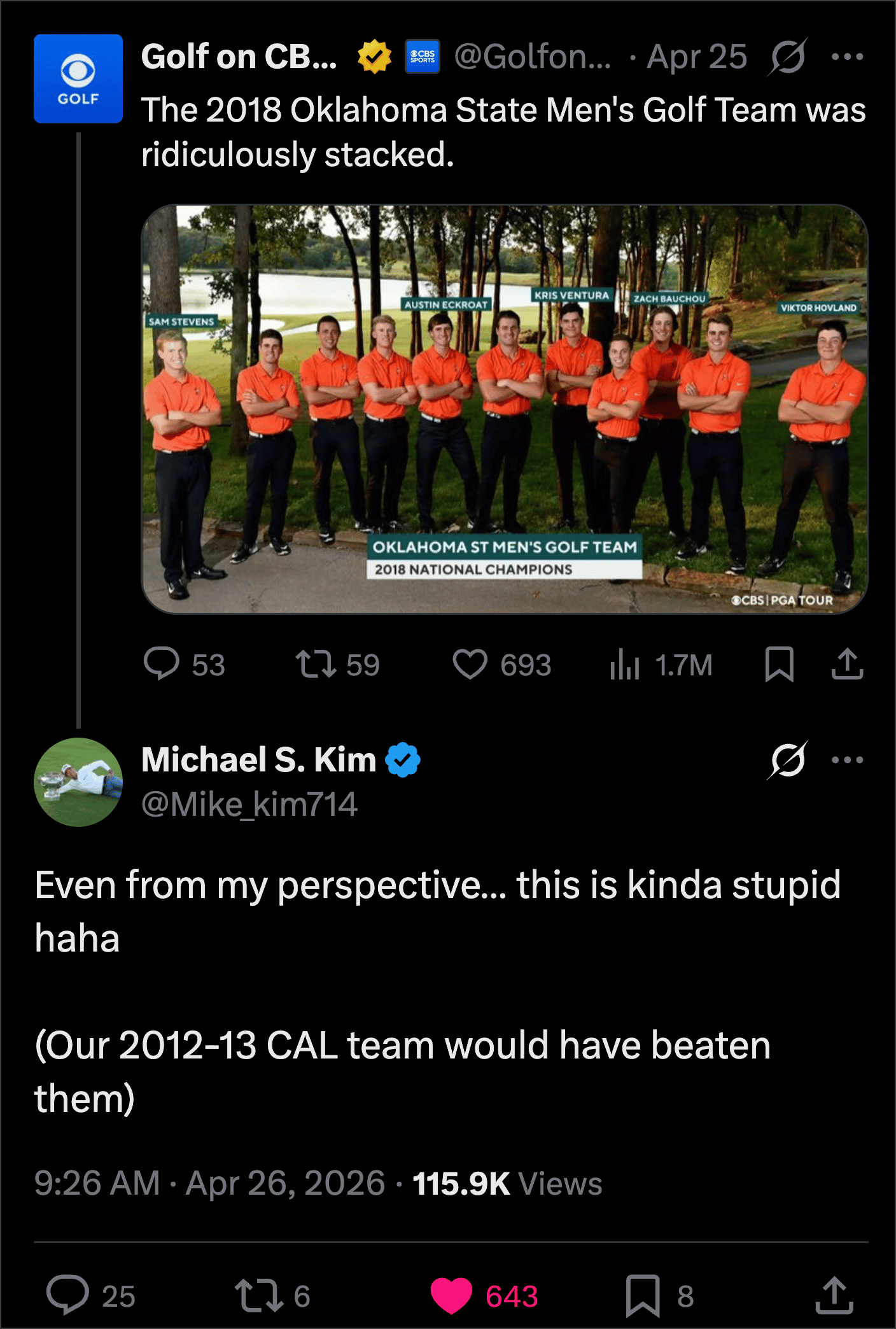
Ignore CBS forgetting to include Matt Wolff in this graphic from a few weeks ago. Instead, let’s talk about whether Michael Kim is right.
Here’s the setup.
2017-18 Oklahoma State: Hovland (70.1), Wolff (70.1), Kris Ventura (71.65), Zach Bauchou (71.1), Austin Eckroat (71.9) and Sam Stevens (who never played).
2012-13 Cal: Kim (70.7 scoring average), Max Homa (71.7), Brandon Hagy (71.7), Michael Weaver (71.9) and Joel Stalter (71.8).
Both teams having all five players average under 72.0 is crazy, but I still have that 2018 Oklahoma State team (which also might not even be the best OSU team!) over Cal. Austin Eckroat was its worst player (as a freshman). That is insane. Its worst player is a PGA Tour winner.
Need to grab my guy, Sean Martin, and do a pod on this at some point.
Illustrator Thoughts
Often I include what readers have sent in via email, but today I wanted to highlight something illustrator Jason wrote out last week on Bryson.
I thought it was lovely and great and wanted to share it.
With the LIV + Bryson + new investor talks, there is a very interesting parallel to what Conan said about the future of late night TV in this article.
"Twenty-seven minutes of O’Brien going absolutely feral [on Hot Ones] as the wings got spicier and spicier, more pop performance art than comedy, hijacked the news cycle. His name was so inescapable on social media that some friends initially worried he’d died. The episode has since logged more than 15 million views on YouTube alone.
“That was the moment the scales fell from my eyes,” he says. “If a guy can do World Series numbers with overhead that looked, to me, to be about $600, and you have every big star lining up to do his show or Chicken Shop Date … that’s when I profoundly understood that late night shows are in trouble.”
Bryson's Youtube represents an alternative form of golf media that is 100 times more effective and 1 million times less expensive to make than LIV.
Golf — because it can be (interestingly) played by one individual and filmed by one other — is uniquely positioned to capitalize on this reality in ways other sports are just not.
Love Your Work
I came across this little clip over the weekend of a podcast cohort discussing a question that I love to ask and have asked in various forms.
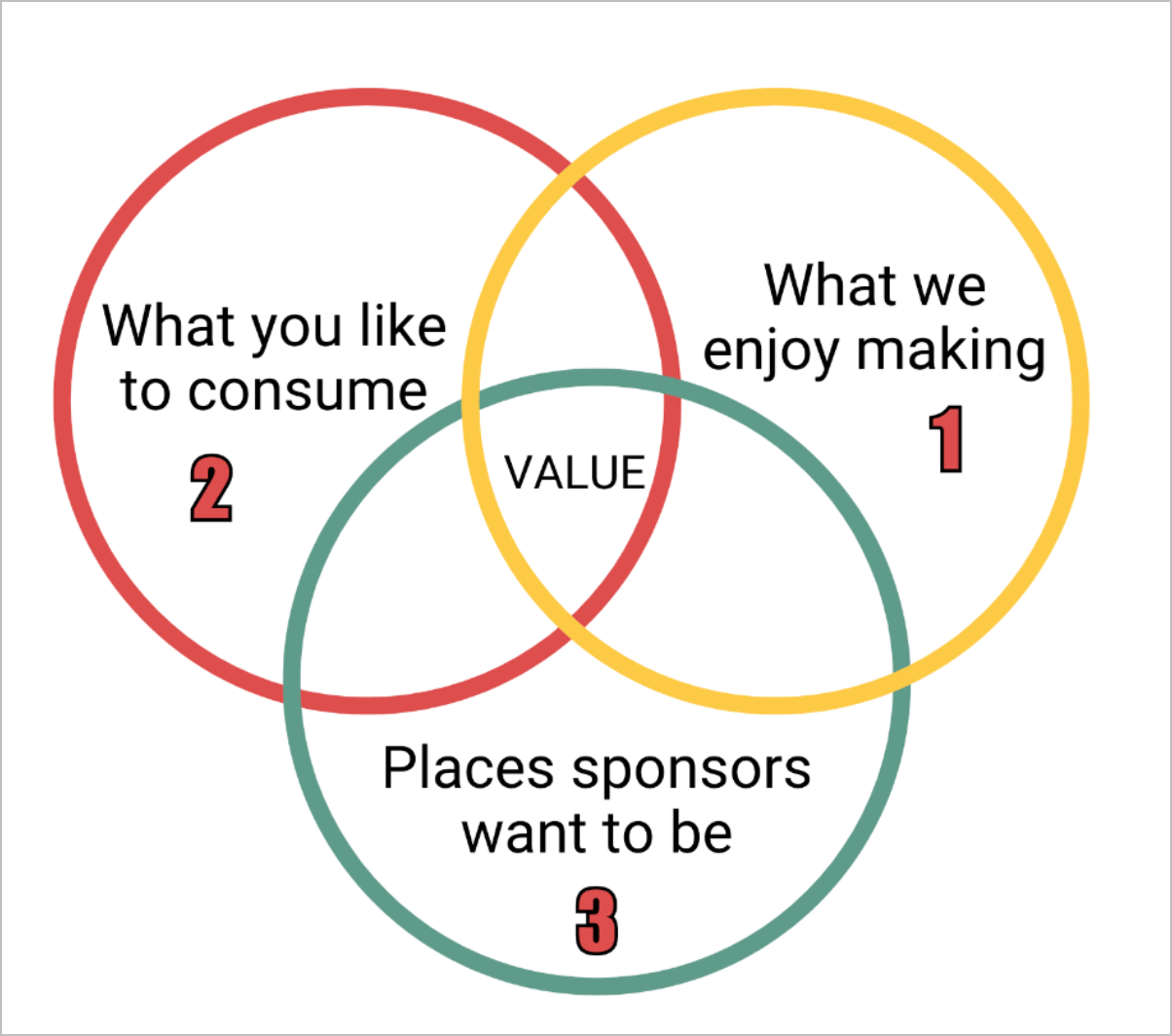
My current answer: Physical artifacts. This is actually becoming my thesis for Normal Sport in some ways. I wrote about this last Monday, but I think as more of the world hurtles toward digital, I am increasingly comfortable with moving the other way. Print. Physical newsletters. Coloring books with Jason’s illustrations.
And on and on we could go.
I don’t know that this is right or that it is wise. It’s definitely a risk because the playbook for it actually working in 2026 isn’t totally established.
But when you’re a micro business like ours, risk is sort of baked into what you have to do to succeed. And if the risk for making all of this work is making what I want to make for people I want to make it for and it still doesn’t work, I can be OK with that. Because the entire point of starting your own business is finding this middle.
Thank you for reading our outrageous golf newsletter that is sometimes — but often barely — about golf and for reckoning with the golf world alongside us. Every edition is algorithm-free and handcrafted by me (Kyle) and Jason. It is a joy for us to build and to publish it for you to read. As always, we hope you love it.


.svg)