Greetings to fellow over-analyzers of team events!
Here’s the #content plan for this week.
Monday — Today’s newsletter: Some thoughts on the teams (mostly the U.S. side) from the Presidents Cup. Critiques, observations and notes.
Tuesday — Podcast: Takeaways from the event and the teams going forward.
Wednesday or Thursday — Newsletter: A deeper dive into some of the individuals that make them up. JT, Koivun, Scottie, Si Woo and plenty more. If we don’t mention those guys today it’s because we’re saving them for part 2 of our look at the Presidents Cup.
Let’s get right to work!
Name drops today: Annie Duke, Darren Rovell, Luke Donald, Cara Banks, Jackson Koivun and Nico Echavarria.
Today’s newsletter is presented by Sap’s Original, which we are guessing some of the Americans — and definitely Chris Gotterup — could be in need of the day after celebrating a come-from-behind Presidents Cup victory.
Why?
Well Sap’s Original provides an ingredient stack that actually works together. Does Gotterup need electrolytes for hydration following Sunday’s celly? Guessing yes!
Does he need adaptogens for stress and balance? Probably!
What about aminos to help his body recover faster? Given what it looked like he was about to put away on Sunday evening? 💯
Thankfully, Sap’s is easy to drink, hard-working fuel. Light, crushable, and — similar to that other stuff that was being consumed on Sunday — still refreshing in a can.
It delivers serious hydration and performance support, and you can pick some up on Amazon right here.
And now, onto the news.

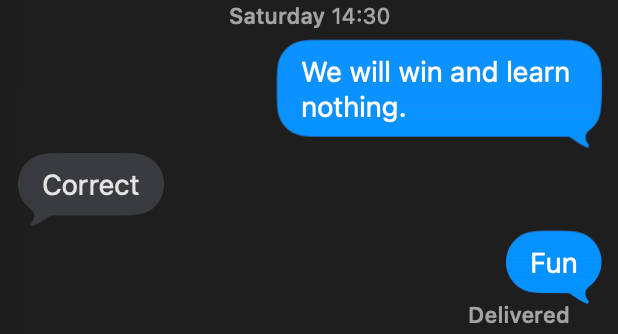
1. I sent this text to another Golf Media Person on Saturday afternoon when the U.S. led all four alternate shot matches, and it appeared as if the Miracle at Medinah™️ was well underway.

I think this is more or less how things played out over the weekend (as KVV also noted in his terrific recap for the International side).
For some reason, as I write this, I am reminded of 2016 at Hazeltine. The Euros got stomped — just absolutely routed — went on to held a tremendous press conference on Sunday evening and then promptly returned to their process.
They have lost one time since then.
Why does this come to mind when the U.S. just … won?
Because I believe that the U.S. teams believe that results matter more than process — or at least enough that they haven’t implemented a consistent process to date — and I don’t think that’s a very good way to look at these events.
In other words, I think some folks on the U.S. side could stand to read Annie Duke’s book, Thinking in Bets or something similar.
Here’s the summary of that book …
But professional poker players are comfortable with the fact that great decisions don't always lead to great outcomes and bad decisions don't always lead to bad outcomes.
By shifting your thinking from a need for certainty to a goal of accurately assessing what you know and what you don't, you'll be less vulnerable to reactive emotions, knee-jerk biases, and destructive habits in your decision making. You'll become more confident, calm, compassionate and successful in the long run.
Thinking in Bets
We cannot and should not look at results — a win! — and believe that the process was good. Just as the Europeans did not look at results in 2016 — an obliteration! — and believe that the process was the problem.
2. I am also reminded of when Jim Furyk went on the NLU pod after losing Paris in 2018 and said the following.
I guess the ... comment that surprises me, it shocks me the most is I've had a handful of people come up and say, “You know, if you got to do it all over again, would you do something different?” And I almost laugh.
I'm like, Well, what arrogant asshole would have the event go the wrong way and then say, “Nope. I'd do everything the same way?”
Jim Furyk
I wrote recently about how much I loved this quote, and I do. I think it shows a ton of humility and is probably true.
However, I also think it’s emblematic of the fact that the U.S. just has bad processes or worse, no consistently present processes at all. They seem to have little to hold onto. No playbook to turn back to when things are going poorly. It very much feels like they’re making it up as they go, especially from one year to the next.
Throw in the difference in makeup of the PGA Tour and PGA of America, and the entire thing seems to be blown about by the wind, but the U.S. often gets crowned in the end because they have most of the best players in the world.
3. To be clear, this is not necessarily the captain’s fault. It’s really nobody’s fault. The U.S. — for a lot of different reasons — just doesn’t have the infrastructure or system as the Europeans (and, I believe, the International team).
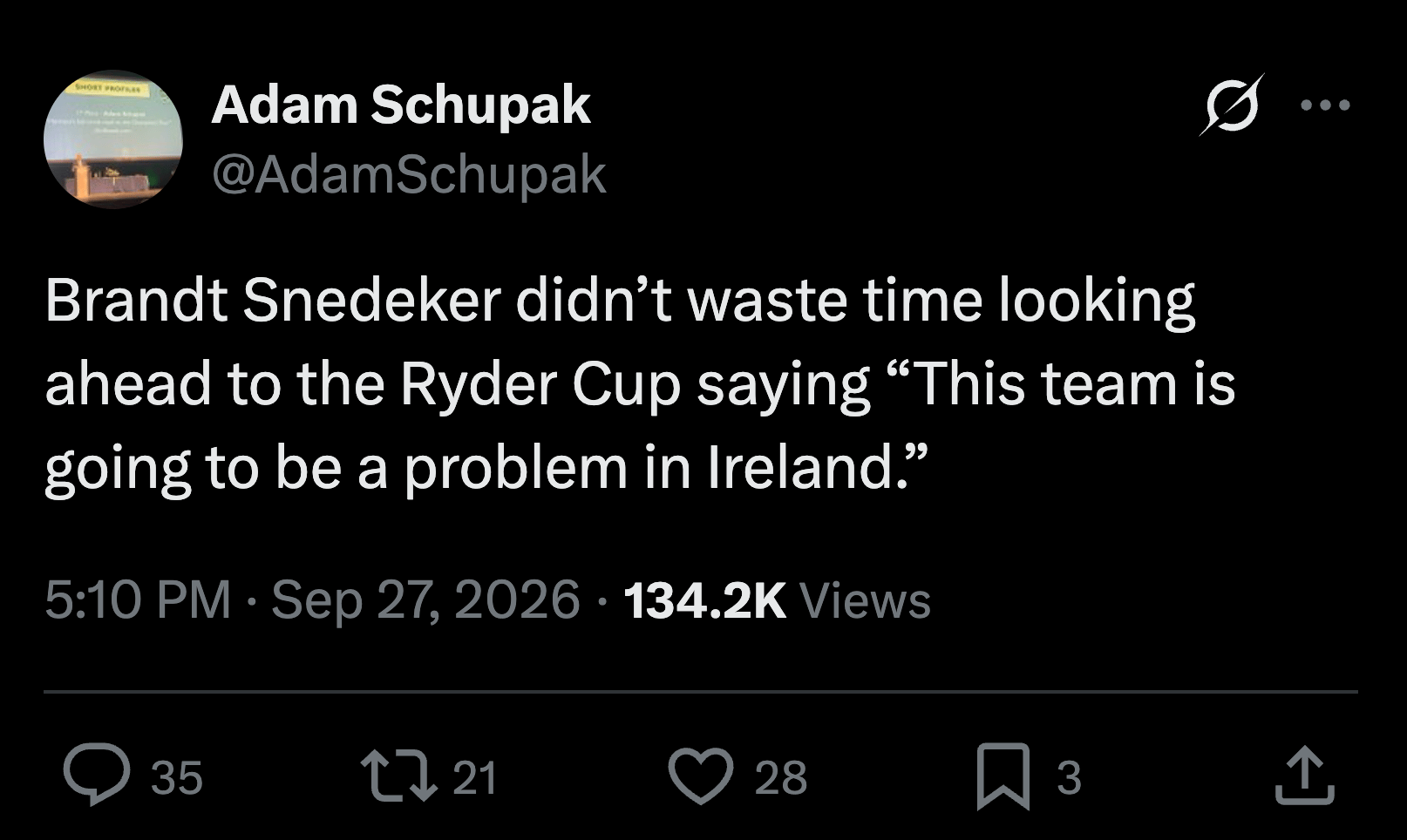
This is why you get Snedeker…
Apologizing for continually putting Scottie/Burns out first because it let Ogilvy react to the best U.S. duo on paper. To repeatedly make this mistake and immediately regret it reads like not knowing how the Presidents Cup matchups were put together, which is odd.
Not really totally knowing why they put certain pairings together (?) like Bridgeman and Henley.
AGAIN offering Scottie up in singles and letting Ogilvy feed him Nico.*
*The argument for this is that the U.S. was trying to bait the Internationals into playing all their bad players first to get momentum. I will concede that could have been the strategy, but given Sneds’ explanation in other areas, I’m unconvinced that it definitely was the strategy.
4. Here’s the argument Data Golf made, though, that none of this even matters.
Now, does any of this incompetence really matter? In the grand scheme, I don’t think it really does. People are really going to dislike this line of thinking, but I think that good versus bad captaining could maybe cost a team half of a Ryder Cup over a couple decades?
That still seems high to me, but the way things are analyzed currently we are giving out full Ryder Cups to individual captaining performances. Going forward, I don’t think the US needs a big restructuring. They need a few competent people in the room that can do the statistical analysis required and give common sense advice to their captains.
Data Golf
I hear that from a statistical standpoint. But I think it underindexes on the idea that good processes and systems lead to trust and comfortability from all parties because they provide stability. Anyone who has ever parented young kids understands this intimately. Do your kids respond better to a good system or an ambiguous one year over year?
I think the U.S. has some pretty ambiguous systems (see above), and that leads to some real lack of trust and comfort, neither of which can be measured in a spreadsheet.
The famous line — which was dropped in our Slack over the weekend — of, “You don't rise to the level of your expectations, you fall to the level of your systems” definitely comes to mind.
Also: I think it’s unfair to critique without offering at least some solutions. If you’re looking for those, I laid them out right here.
5. I thought it was a little bizarre that Snedeker was running around for most of the week telling anyone with a microphone some version of, I screwed up. I let these guys down. Blame me. It’s my fault. All while the U.S. team was only 3-4 points down and with as much as half the competition left.
Almost as if he was operating out of fear and trying to get out ahead of post-event criticism from either inside or outside the U.S. organization.
It made me think about how there are a couple different schools of thought on how these organizations should be run. This is how I would sum them up when it comes to team events.
Europeans (and Internationals): Traditional hierarchy, top down leadership.
Americans: Very flat organization, captains and players have similar power.
On the Euro side, you have Rory McIlroy and Jon Rahm publicly and privately submitting their careers and their legacies to [checks notes] Luke Donald. Think about how much humility that takes. This also seems like what’s taking place on the International side as well.
On the American side, it sometimes feels like the captain is technically running everything, but everything is just flatter. You know how when you’re coaching youth sports and everyone asks you to play shortstop and quarterback? That’s how some of these teams feel like they’re run some of the time.

Because there is change between the PGA and PGA Tour between Presidents Cup and Ryder Cup and seemingly no super consistent process, it makes sense that the players would try and take charge. But this so often leads to weak leadership, bad vision and little accountability (see: how the PGA Tour has been run over the last 10 years!)
6. To be fair to everyone involved, I should note that the U.S. might have an amazing process and be executing it behind the scenes far better than I understand.
I will own that.
However, after observing and taking in everything this week (and in previous cup weeks), you have to suspend quite a bit of disbelief and basically squint with your eyes closed to think this is true.
They don’t really seem to adhere to statistics at all at times (see: Henley and Scheffler teeing off on the wrong holes at Bethpage and the caddies figuring that one out), and if there was even a basic explanation of the process of putting pairings together this week, I missed it.
This clip right here bothered me on that front. Here’s Snedeker explaining why Bridgeman and Henley played together …
Russell Henley is the 6th ranked player in the world. Jacob Bridgeman won last week on the PGA Tour. I think it's a pretty strong pairing. I know it didn't go the way those guys wanted. I thought they competed hard today. I'm sure there's a few shots that both those guys want back.
I mean, good Lord, guys, 6th player in the world and Jacob Bridgeman, those guys are studs.
Q. Is there anything in the numbers or anything that suggested they were beyond -- I mean, all 12 of your guys have great resumes. Is there anything that suggested for alternate shot they were good partners?
I felt like they were. I felt like the numbers backed that up. I felt like, especially on this golf course, the way those guys can kind of hit fairways and put pressure on groups, I thought it was going to be a good matchup. I've still got tons of faith in those guys. Those guys are going to go out there tomorrow and play some great golf for us.
Brandt Snedeker
Again, what is the detailed process here? Looking at a sheet of paper and saying “those guys are good and like each other”? Surely not, right? That sounds like something out of the 1990s at these events.
Surely the U.S. has its own detailed process, but I haven’t really heard it articulated or explained coherently in a while. This leads me to believe the behind-the-scenes work is a bit dodgy as well, which — like I’ve been proselytizing — can lead to a lack of trust from everyone involved.
At the very least — even if the process is in fact guys who like each other — give them some confidence boost by saying, Well Russ the way the course is set up, Russ is going to hit a lot of drives into that 100-150 range, and Jacob is elite from 100-150 yards (which is true). Again, maybe this is happening behind the scenes but it’s definitely not happening in front of them.
But because we won on Sunday and Jackson Koivun twirled his club a few times (which, objectively was sick) and the final was 17-13, I am unconvinced that the U.S. will implement any meaningful overhaul going forward.
To be fair, I would have — for a variety of reasons — been unconvinced it would have done this even if the International team had won.
7. I almost laughed out loud at this Snedeker quote after the U.S. won on Sunday.
I'm tired of hearing how these guys aren't close. I'm tired of hearing how we can't play team golf. Guys just proved it right then and there.
Brandt Snedeker
Brother, these U.S. teams have played 68 team golf matches (four ball and alternate shot) in the last four Presidents Cups and Ryder Cups and their record is …
26 wins
37 losses
5 halves
… despite having better or equivalent teams compared to their opponents. Let’s not sweep that under the rug just because of a good singles session on Sunday.
Also, more broadly, I feel like the U.S. side was pretty impatient and short with media in general this week. Between Sneds saying “Good Lord, guys” when asked about why he paired Henley and Bridgeman and Scottie popping Cara for asking the question everyone was talking about throughout Saturday and Sunday (why he sat), it just feels a bit like these guys are not used to criticism or questioning at all and often caught off guard when it happens at these team events (and I’m not the only one who thinks this).
8. If we want to talk about positives, let’s talk about how I do believe the first part of that Sneds quote. I think this generation of players does care pretty deeply about one another and is legit close. I think they are probably as exasperated as the rest of us at the four ball and alternate shot stuff.
And they deserve a ton of credit for answering the bell on Sunday when they had to have it. We’ll do 1,500 words on talk about Jackson Koivun later this week, but my gosh. To hit those shots under that pressure is insane. And he wasn’t the only one.
It would have been so easy to crumble, and it took everyone on Sunday to win. There’s a lot of “I hate these guys they don’t care and they suck and they don’t show emotion” from U.S. fans. But you don’t do what they did on Sunday if you don’t care.
Both about the event and for one another.
9. If you’re interested in any of what I’ve been writing about, you should go watch the postgame presser with the entire team. It … didn’t seem very joyful. Once the work was done, it seemed like they were more relieved about the win and tired of talking to the media than anything else.
Scottie gesticulating every other question. Sneds making halfhearted jokes. Nobody really truly backing him and his captaincy. The most passionate thing anyone does is JT talking about Jackson Koivun, and then Furyk jumps in at the end and opines on the future. The whole thing is just a little uneven.
Which … whatever. You don’t need to win the presser, and I don’t think it contrasts my previous point. But it’s another data point in the case against the U.S. having a truly great system and everyone pulling on the same rope in the same direction.
Joel Beall’s article was pretty devastating on this front as well.
10. DJ Pie had a good take that was basically, These events rule because we can’t spreadsheet them. Can’t optimize them. Can’t figure them out.
It pairs nicely with my take that the Ryder Cup (and apparently now Presidents Cup) is amazing because it’s just long enough to find some patterns but far too short for any of them to be meaningful statistically.
So when you have a theory about why a team does well or does poorly, it definitely could be true because basically anything can be true in events this short.
Here’s Data Golf.
As for what happened this week… I think there is plenty to criticize with the U.S. leadership, but I would not base much of that on what actually played out on the course. The U.S. got swept in the first foursomes session and split the second, pushing their record to 8-26 since 2023.
Much was made of this online, but as Will pointed out, before 2023 the Americans were a force in foursomes. Even if you are fully convinced that the U.S. has no idea what they are doing with their foursomes pairings, there just isn’t much explanatory power with those kinds of captaining and strategic edges.
It’s worth a percentage point here or there, but the reality is that almost all of that 8-26 record is noise. It’s an unsatisfactory explanation, but it’s true.
Data Golf
Again, this discounts the importance of solidarity and working together as one tremendous machine (see No. 4), but it also gets at what DJ is saying (and I have said) above.
This noise is responsible for fans freaking out, thinking they have the answers and wanting everything to change after nearly every session. Which, yes, must be tiresome for these teams but to again quote Darren Rovell, makes for the most tremendous content.
11. Oh no.

Just … why would you do this?

12. We’ll end where I always like to end with these things: With humility. I wrote about this on Saturday morning, and I will continue writing about it in the future.
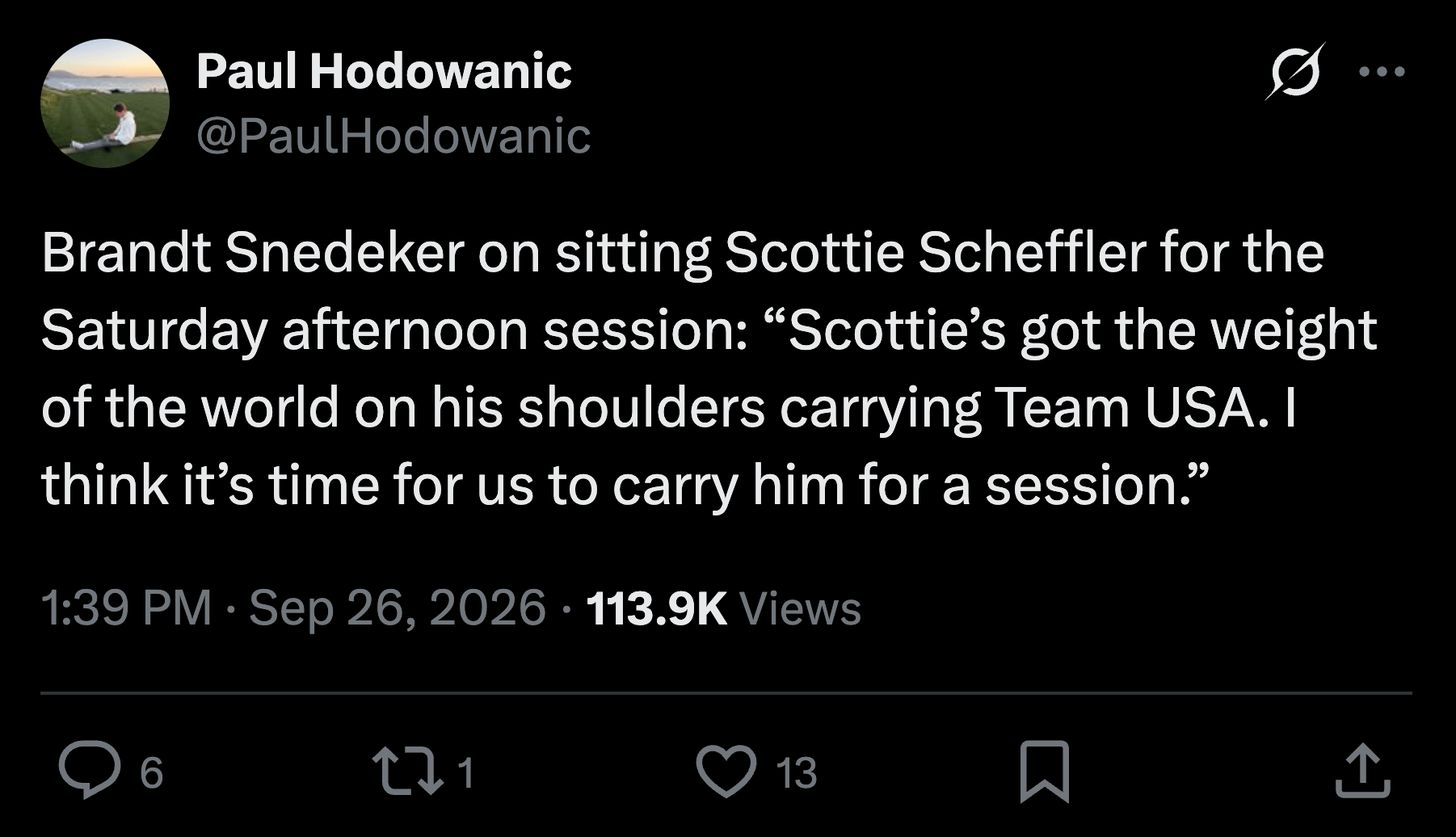
Here’s what Sneds said about sitting Scottie on Saturday afternoon.

The quote is not good, but the bigger picture problem is that U.S. players often see the pressure of these events as a weight and a burden when the reality should be that it is an opportunity and a joy.
The reason — in my opinion — that they see the pressure here as a weight and a burden is because they are told to “remember who you are.” Go out there and be who everyone thinks you are!
This burden can be devastatingly heavy (see above).
In contrast, Europe is forgetful. Forget who you are. We are all one this week. That is it.
It's the ability to walk through those gates and those doors and forget about who you are outside of this week, what you have done or what you may do afterwards, really truly doesn't matter.
Jon Rahm
I don’t think the U.S. understands this, and I’m not sure it ever will.

In all of this, I don’t believe there are more than five people — who are not actually involved in the event — who care about this stuff as much as I do.
Which means I am for sure over-analyzing everything at a microscopic level. But if you can’t do what you love — I would literally write about these events in every single edition if I thought people would read them — inside a golf media business that you own, then there is no point in owning a golf media business.
So thank you as always for supporting us with your time and attention. We will continue giving everything we have when it comes to these tournaments and these simultaneously meaningless but also incredibly meaningful events.
We appreciate you reading.

Greetings to fellow over-analyzers of team events!
Here’s the #content plan for this week.
Monday — Today’s newsletter: Some thoughts on the teams (mostly the U.S. side) from the Presidents Cup. Critiques, observations and notes.
Tuesday — Podcast: Takeaways from the event and the teams going forward.
Wednesday or Thursday — Newsletter: A deeper dive into some of the individuals that make them up. JT, Koivun, Scottie, Si Woo and plenty more. If we don’t mention those guys today it’s because we’re saving them for part 2 of our look at the Presidents Cup.
Let’s get right to work!
Name drops today: Annie Duke, Darren Rovell, Luke Donald, Cara Banks, Jackson Koivun and Nico Echavarria.
Today’s newsletter is presented by Sap’s Original, which we are guessing some of the Americans — and definitely Chris Gotterup — could be in need of the day after celebrating a come-from-behind Presidents Cup victory.
Why?
Well Sap’s Original provides an ingredient stack that actually works together. Does Gotterup need electrolytes for hydration following Sunday’s celly? Guessing yes!
Does he need adaptogens for stress and balance? Probably!
What about aminos to help his body recover faster? Given what it looked like he was about to put away on Sunday evening? 💯
Thankfully, Sap’s is easy to drink, hard-working fuel. Light, crushable, and — similar to that other stuff that was being consumed on Sunday — still refreshing in a can.
It delivers serious hydration and performance support, and you can pick some up on Amazon right here.
And now, onto the news.

1. I sent this text to another Golf Media Person on Saturday afternoon when the U.S. led all four alternate shot matches, and it appeared as if the Miracle at Medinah™️ was well underway.

I think this is more or less how things played out over the weekend (as KVV also noted in his terrific recap for the International side).
For some reason, as I write this, I am reminded of 2016 at Hazeltine. The Euros got stomped — just absolutely routed — went on to held a tremendous press conference on Sunday evening and then promptly returned to their process.
They have lost one time since then.
Why does this come to mind when the U.S. just … won?
Because I believe that the U.S. teams believe that results matter more than process — or at least enough that they haven’t implemented a consistent process to date — and I don’t think that’s a very good way to look at these events.
In other words, I think some folks on the U.S. side could stand to read Annie Duke’s book, Thinking in Bets or something similar.
Here’s the summary of that book …
But professional poker players are comfortable with the fact that great decisions don't always lead to great outcomes and bad decisions don't always lead to bad outcomes.
By shifting your thinking from a need for certainty to a goal of accurately assessing what you know and what you don't, you'll be less vulnerable to reactive emotions, knee-jerk biases, and destructive habits in your decision making. You'll become more confident, calm, compassionate and successful in the long run.
Thinking in Bets
We cannot and should not look at results — a win! — and believe that the process was good. Just as the Europeans did not look at results in 2016 — an obliteration! — and believe that the process was the problem.
2. I am also reminded of when Jim Furyk went on the NLU pod after losing Paris in 2018 and said the following.
I guess the ... comment that surprises me, it shocks me the most is I've had a handful of people come up and say, “You know, if you got to do it all over again, would you do something different?” And I almost laugh.
I'm like, Well, what arrogant asshole would have the event go the wrong way and then say, “Nope. I'd do everything the same way?”
Jim Furyk
I wrote recently about how much I loved this quote, and I do. I think it shows a ton of humility and is probably true.
However, I also think it’s emblematic of the fact that the U.S. just has bad processes or worse, no consistently present processes at all. They seem to have little to hold onto. No playbook to turn back to when things are going poorly. It very much feels like they’re making it up as they go, especially from one year to the next.
Throw in the difference in makeup of the PGA Tour and PGA of America, and the entire thing seems to be blown about by the wind, but the U.S. often gets crowned in the end because they have most of the best players in the world.
3. To be clear, this is not necessarily the captain’s fault. It’s really nobody’s fault. The U.S. — for a lot of different reasons — just doesn’t have the infrastructure or system as the Europeans (and, I believe, the International team).
This is why you get Snedeker…
Apologizing for continually putting Scottie/Burns out first because it let Ogilvy react to the best U.S. duo on paper. To repeatedly make this mistake and immediately regret it reads like not knowing how the Presidents Cup matchups were put together, which is odd.
Not really totally knowing why they put certain pairings together (?) like Bridgeman and Henley.
AGAIN offering Scottie up in singles and letting Ogilvy feed him Nico.*
*The argument for this is that the U.S. was trying to bait the Internationals into playing all their bad players first to get momentum. I will concede that could have been the strategy, but given Sneds’ explanation in other areas, I’m unconvinced that it definitely was the strategy.
4. Here’s the argument Data Golf made, though, that none of this even matters.
Now, does any of this incompetence really matter? In the grand scheme, I don’t think it really does. People are really going to dislike this line of thinking, but I think that good versus bad captaining could maybe cost a team half of a Ryder Cup over a couple decades?
That still seems high to me, but the way things are analyzed currently we are giving out full Ryder Cups to individual captaining performances. Going forward, I don’t think the US needs a big restructuring. They need a few competent people in the room that can do the statistical analysis required and give common sense advice to their captains.
Data Golf
I hear that from a statistical standpoint. But I think it underindexes on the idea that good processes and systems lead to trust and comfortability from all parties because they provide stability. Anyone who has ever parented young kids understands this intimately. Do your kids respond better to a good system or an ambiguous one year over year?
I think the U.S. has some pretty ambiguous systems (see above), and that leads to some real lack of trust and comfort, neither of which can be measured in a spreadsheet.
The famous line — which was dropped in our Slack over the weekend — of, “You don't rise to the level of your expectations, you fall to the level of your systems” definitely comes to mind.
Also: I think it’s unfair to critique without offering at least some solutions. If you’re looking for those, I laid them out right here.
5. I thought it was a little bizarre that Snedeker was running around for most of the week telling anyone with a microphone some version of, I screwed up. I let these guys down. Blame me. It’s my fault. All while the U.S. team was only 3-4 points down and with as much as half the competition left.
Almost as if he was operating out of fear and trying to get out ahead of post-event criticism from either inside or outside the U.S. organization.
It made me think about how there are a couple different schools of thought on how these organizations should be run. This is how I would sum them up when it comes to team events.
Europeans (and Internationals): Traditional hierarchy, top down leadership.
Americans: Very flat organization, captains and players have similar power.
On the Euro side, you have Rory McIlroy and Jon Rahm publicly and privately submitting their careers and their legacies to [checks notes] Luke Donald. Think about how much humility that takes. This also seems like what’s taking place on the International side as well.
On the American side, it sometimes feels like the captain is technically running everything, but everything is just flatter. You know how when you’re coaching youth sports and everyone asks you to play shortstop and quarterback? That’s how some of these teams feel like they’re run some of the time.

Because there is change between the PGA and PGA Tour between Presidents Cup and Ryder Cup and seemingly no super consistent process, it makes sense that the players would try and take charge. But this so often leads to weak leadership, bad vision and little accountability (see: how the PGA Tour has been run over the last 10 years!)
6. To be fair to everyone involved, I should note that the U.S. might have an amazing process and be executing it behind the scenes far better than I understand.
I will own that.
However, after observing and taking in everything this week (and in previous cup weeks), you have to suspend quite a bit of disbelief and basically squint with your eyes closed to think this is true.
They don’t really seem to adhere to statistics at all at times (see: Henley and Scheffler teeing off on the wrong holes at Bethpage and the caddies figuring that one out), and if there was even a basic explanation of the process of putting pairings together this week, I missed it.
This clip right here bothered me on that front. Here’s Snedeker explaining why Bridgeman and Henley played together …
Russell Henley is the 6th ranked player in the world. Jacob Bridgeman won last week on the PGA Tour. I think it's a pretty strong pairing. I know it didn't go the way those guys wanted. I thought they competed hard today. I'm sure there's a few shots that both those guys want back.
I mean, good Lord, guys, 6th player in the world and Jacob Bridgeman, those guys are studs.
Q. Is there anything in the numbers or anything that suggested they were beyond -- I mean, all 12 of your guys have great resumes. Is there anything that suggested for alternate shot they were good partners?
I felt like they were. I felt like the numbers backed that up. I felt like, especially on this golf course, the way those guys can kind of hit fairways and put pressure on groups, I thought it was going to be a good matchup. I've still got tons of faith in those guys. Those guys are going to go out there tomorrow and play some great golf for us.
Brandt Snedeker
Again, what is the detailed process here? Looking at a sheet of paper and saying “those guys are good and like each other”? Surely not, right? That sounds like something out of the 1990s at these events.
Surely the U.S. has its own detailed process, but I haven’t really heard it articulated or explained coherently in a while. This leads me to believe the behind-the-scenes work is a bit dodgy as well, which — like I’ve been proselytizing — can lead to a lack of trust from everyone involved.
At the very least — even if the process is in fact guys who like each other — give them some confidence boost by saying, Well Russ the way the course is set up, Russ is going to hit a lot of drives into that 100-150 range, and Jacob is elite from 100-150 yards (which is true). Again, maybe this is happening behind the scenes but it’s definitely not happening in front of them.
But because we won on Sunday and Jackson Koivun twirled his club a few times (which, objectively was sick) and the final was 17-13, I am unconvinced that the U.S. will implement any meaningful overhaul going forward.
To be fair, I would have — for a variety of reasons — been unconvinced it would have done this even if the International team had won.
This post will continue below for Normal Club members (all 1,056 of them) and includes more interesting U.S. quotes, an Adare Manor prediction (!!) and ending where we always end, with humility.
By becoming a member, you will receive the following …
• Access to 100 percent of our content this week.
• An invite to our Slack channel where we watch and talk golf together.
• A free digital copy of our Rory book.
• 15% off to our pro shop.